Blog has moved, searching new blog...

Showing posts with label Spiritual Formation. Show all posts

Monday, November 1, 2010

The Embrace of Contemplative Spirituality in the (Post)Modern Church


By Justin Edwards

Lighthouse Trails Research has just posted a revealing article illustrating the extent to which contemplative spirituality and mysticism (CSM) has infiltrated the evangelical church. In a new book titled, The Big Book of Christian Mysticism, author Carl McColman explains there is no distinction between Christian mysticism and non-Christian mysticism. Proponents of contemplative prayer include Brian McLaren, Leonard Sweet, Tony Campola, Richard Rohr, Richard Foster, Dallas Willard, Rob Bell, and Phyllis Tickle who embrace the teachings of mystics Thomas Merton, Brennan Manning, Henri Nowen, and Brother Lawrence. However, you might be surprised to learn popular teachers such as Rick Warren, Beth Moore, Mark Driscoll, Bill Hybels, Max Lucado, John Ortberg, and even a major Christian empire like Focus on the Family endorse these practices.

Please take the time to see how these share a common thread in contemplative spirituality by clicking on the following link to the LHTR blog: Brian McLaren and Richard Foster’s Editorial Team Agree with Lighthouse Trails – Contemplative Prayer and Eastern Mysticism Are Same Thing

The article closes with this bottom line and offers the concluding p.s.:

To those who know and embrace the glorious Gospel of Christ, there can be no fellowship with religions that reject the very foundation of the biblical Christian faith. Something is radically wrong when someone who claims to be a Christian has a sense of solidarity with someone who has a view that man is divine (i.e., man is God). Shear logic should point out the truth of what we are trying to say. Lighthouse Trails’ hope is that you look at this issue with an open mind and honest discernment. The truth is in plain view.

P.S. If you have had family members or friends who have rejected or ridiculed you for speaking up against contemplative spirituality (i.e., spiritual formation), show them this article.

This is that important. You might also want to check out the following post that lists common buzzwords and major proponents of CSM:  Emergence Christianity - Naming Names and Providing Terms. Please don't sweep this under the rug or brush it off and accuse these matters as legalism. The visible church is very sick, and it's a blaring indication that Jesus Christ is coming for His True Church soon. What we are witnessing is the falling away of the church (2 Thessalonians 2:3), and we must arm ourselves with the whole armor of God and defend the Gospel of the Lord Jesus Christ. Deception is running amok, and it's imperative we cling to sound doctrine, never compromising the truth.

Please heed the warnings.

Monday, August 16, 2010

Beth Moore et al and Contemplative Prayer


By Lighthouse Trails Research Editors


In the August 2010 cover story of Christianity Today, the magazine has brought out two things that the major Christian media has thus far ignored – one, that Beth Moore, described as “the most popular Bible teacher in America”  by CT is a proponent of contemplative prayer, and two, that there is a debate over whether contemplative meditation is of Eastern religious origin or not. This Lighthouse Trails special report will look at both of these facets, Beth Moore’s contemplative propensities (incidentally, she is noted in CT  for influencing “millions” of women) and the vital question as to whether contemplative prayer is indeed rooted in Eastern mysticism.

Christianity Today hit the nail right on the head when it informed its readers that:

“Critics argue that contemplative prayer is rooted in Eastern mysticism and thus not a practice that Christians should engage in.”

Lighthouse Trails has always warned that contemplative prayer is in fact rooted in Eastern mysticism, with a heavy emphasis on the word “rooted.” In Ray Yungen’s book, A Time of Departing, Yungen brings out that contemplative prayer was created by the Desert Fathers, a group of monks who lived in the desert during the early middle ages. Quoting Ken Kaisch, A Time of Departing reveals:

It was a time of great experimentation with spiritual methods. Many different kinds of disciplines were tried, some of which are too harsh or extreme for people today. Many different methods of prayer were created and explored by them. (Finding God, p. 191).
At the time, the city of Alexandria, close to where the Desert Fathers existed, was a stronghold of Eastern mysticism through the connection of King Alexander’s link to India. It is believed that the Desert Fathers utilized Eastern style meditation practices (i.e., mantra meditation), but instead of using Hindu or Buddhist mantras, they tailored this Eastern style prayer to their Christian beliefs, using “Christian” mantras. As an early treatise on contemplative prayer written by an anonymous monk, The Cloud of Unknowing, describes:  ”Take just a little word, of one syllable rather than of two . . . With this word you are to strike down every kind of thought under the cloud of forgetting.” This is why all the major icons of contemplative prayer (Thomas Merton, Thomas Keating, Henri Nouwen, etc) echo the same spiritual perceptions as Eastern meditation practitioners. Thomas Merton said as he was leaving on a trip to South Asia to address Hindu and Buddhist monks: ” We left the ground– I with Christian mantras and a great sense of destiny, of being at last on my true way after years of waiting and wandering … I am going home, to the home where I have never been in this body. ” (Merton’s Asian Journal, pp. ). Henri Nouwen echoed this when he said that Hinduism, Buddhism, and the Muslim (i.e., Sufism) religion offered many treasures for the spiritual life of the Christian (in the foreword of Thomas Ryan’s Disciplines for Christian Living). 

For those who are still skeptical, the co-founder of one of the largest centers for teaching contemplative prayer, Tilden Edwards of The Shalem Institute, said that contemplative prayer is “the Western bridge to Far Eastern spirituality” (Edwards, Spiritual Friend, p. 18). How much more clear can this be? We could go on and on to verify the link between Eastern religion and contemplative spirituality. We have documented over 200 pages in A Time of Departing, not to mention article after article with continued documentation.

Returning to Beth Moore, while it may come as a surprise to many Christianity Today readers that Moore is being identified with contemplative “mysticism,” it is no surprise to Lighthouse Trails because in the spring of 2006, Moore was included in our coverage of a Fox Home Entertainment film titled Be Still,* an infomercial for contemplative spirituality.  Shortly after the DVD was released, Lighthouse Trails spoke with Moore’s personal assistant who said that Moore did not have a problem with Richard Foster or Dallas Willard’s teachings. To reiterate this, Living Proof Ministries issued a  statement a few weeks after the release of the DVD that stated: “[W]e believe that once you view the Be Still video you will agree that there is no problem with its expression of Truth.” Living Proof offered to send a free copy of the DVD to anyone who receives their email statement and wishes to view the DVD, saying that, “[I]t would be our privilege to do this for you to assure you that there is no problem with Beth’s participation in the Be Still video.” This statement was issued because several women contacted Moore’s ministry after reading the Lighthouse Trail report on the Be Still DVD.

In the Be Still DVD, countless enticements, references, and comments clearly show its affinity with contemplative spirituality. For instance, Richard Foster says that anyone can practice contemplative prayer and become a “portable sanctuary” for God. This backs up other statements by Foster over the course of the past thirty years in which he believes that even a non-believer in Christ can participate in the “spiritual discipline” of silence and have an encounter with God. The assumption by all mystics is that God dwells in all people, and meditation will help them to realize their own Divinity. This panentheistic view of God is very typical for contemplatives. As Ray Yungen points out, those who practice contemplative prayer begin to view God through panentheistic (God in all) and interspiritual (all is united) eyes. Thomas Merton, whom Foster has admired publicly for many years, believed that all human beings have divinity within, and this divinity can be accessed through contemplative prayer, thereby making the Cross of Jesus unnecessary for union with God. We believe that the reason for this change in spiritual outlook for those who continue practicing contemplative meditation (i.e., mantra-like meditation) is that these altered states of consciousness actually engage the practitioner with demonic realms leading to spiritual deception.

The underlying theme of the Be Still DVD is that we cannot truly know God or be intimate with Him without contemplative prayer and the state of silence that it produces. While the DVD is vague and lacking in actual instruction on word or phrase repetition (which lies at the heart of contemplative prayer), it is very misleading, to say the least. What they don’t say in the DVD is that this state of stillness or silence is, for the most part, achieved through some method such as mantra-like meditation. The purpose of the DVD, in essence, is not to instruct in contemplative prayer but rather to make you and your family hungry for it. The DVD even promises that practicing the silence will heal your family problems.

The thoughtful and discerning Christian needs to ask whether the Be Still DVD is an accurate “expression of Truth,” as Beth Moore says it is, and is there truly “no problem with Beth’s participation” in this project? Considering the fact that Christianity Today calls Moore “the most popular Bible teacher in America,” these are fair questions to ask. Moore has the potential of leading  millions of women in a spiritually dangerous direction. Those women in turn will bring this mystical teaching home to their husbands, children, and churches. In the Be Still DVD, Moore states: “[I]f we are not still before Him [God], we will never truly know to the depths of the marrow of our bones that He is God. There’s got to be a stillness.” Moore says that it is not possible to “truly know” that He is God without “a stillness.” She is not talking about a quiet place to pray and spend time in God’s word, but rather she is talking about a stillness of the mind – this is what contemplatives strive for – unless you practice this stillness of the mind, your relationship with the Lord is inadequate. According to Beth Moore, you don’t even know Him in the way you should.

Many reading this may be asking, is there any other evidence as to where Moore really stands with regard to contemplative. The answer to that may at least partially be found in a book she wrote in 2002 called When Godly People Do Ungodly Things. In a section about “Unceasing Prayer,” Moore states:

I have picked up on the terminology of Brother Lawrence [a Carmelite mystic who said he "cried out, singing and dancing  violently like a madman" when he went into the "presence"1], who called praying unceasingly practicing God’s presence. In fact, practicing God’s presence has been my number one goal for the last year. (p. 109)
Moore says: “A head full of biblical knowledge without a heart passionately in love with Christ is terribly dangerous–a stronghold waiting to happen. The head is full, but the heart and soul are still unsatisfied” (p. 60). This language is very indicative of contemplatives and echoes Richard Foster who said we have become barren within or Rick Warren who says the church is not fully mature without spiritual formation ala Foster and Willard (i.e., contemplative prayer)  (The Purpose Driven Church, p. 126-127 ). However, all of this talk leads one to think that the Word of God is little more than a philosophy and needs the help of contemplative prayer to be effective at all. The insinuation is that the Holy Spirit is dormant and ineffective without this vital stimuli.  Contemplatives are making a distinction between studying and meditating on the Word of God versus loving Him, suggesting that we cannot love Him or know Him simply by studying His Word or even through normal prayer–we must practice contemplative to accomplish this. But the Bible makes it clear that the Word of God is living and active, and it is in filling our minds with it that we come to love Him and know Him, not through a mystical practice that is never once mentioned in the Bible, except in warnings against vain repetitions (Matthew 6:7) and Old Testament warnings against seeking to make contact with the spirit world or going into altered states of consciousness (Deuteronomy 18:11).

In Moore’s book, she makes frequent references to contemplative pioneer Brennan Manning, stating that his contribution to “our generation of believers may be a gift without parallel” (p. 72). This is indeed a troubling statement made by “the most popular Bible teacher in America.”  No doubt, many of the women who follow Moore, in reading her comments about Manning and her quoting of him have turned to the writings of Manning for further insights. Why wouldn’t they when their favorite Bible teacher speaks so highly of him? When they do turn to him, they will find that Manning is a devout admirer of Beatrice Bruteau, founder of  The School for Contemplation. Bruteau wrote the foreword to a book called The Mystic Heart by New Age mystic Wayne Teasdale, a book that actually lays out that contemplative prayer will unite Christianity with all the world’s religions at a mystical level. And yet, in Manning’s book, Abba’s Child, he says that Bruteau is a “trustworthy guide to contemplative consciousness.”  Manning  backs his love for “contemplative consciousness” by stating the following:

[T]he first step in faith is to stop thinking about God at the time of prayer. (The Signature of Jesus, p. 212)

Choose a single, sacred word or phrase that captures something of the flavor of your intimate relationship with God. A word such as Jesus, Abba, Peace, God or a phrase such as “Abba, I belong to you.” … Without moving your lips, repeat the sacred word inwardly, slowly, and often. (SoJ, p. 218)

When distractions come, … simply return to listening to your sacred word…. [G]ently return [your mind] to your sacred word. (SoJ, p. 218)

[E]nter into the great silence of God. Alone in that silence, the noise within will subside and the Voice of Love will be heard. (SoJ, p. 218)
This is the contemplative prayer that Beth Moore is promoting – Manning’s contemplative prayer. Furthering Beth Moore’s great admiration for Manning, she quotes him from his book Ragamuffin Gospel calling the book “one of the most remarkable books” (p. 290) she has ever read. But it is this very book that reveals Manning’s true affinity with contemplative spirituality. In the back of the book, Manning makes reference to Catholic priest and mystic Basil Pennington saying that Pennington’s methods will provide us with “a way of praying that leads to a deep living relationship with God.” However, most assuredly Pennington’s methods of prayer draw from Eastern religions. In his book, Finding Grace at the Center, Pennington says:

We should not hesitate to take the fruit of the age-old wisdom of the East and “capture” it for Christ. Indeed, those of us who are in ministry should make the necessary effort to acquaint ourselves with as many of these Eastern techniques as possible. Many Christians who take their prayer life seriously have been greatly helped by Yoga, Zen, TM and similar practices. (from A Time of Departing, 2nd ed., p.64, quoting Finding Grace at the Center, pp. 5-6)
Pennington also says that the Holy Spirit is the soul of the human family (Centered Living, The Way of Centering Prayer, p. 104).

In Ragamuffin Gospel, Manning cites Carl Jung as well as interspiritualists and contemplative msytics, Anthony De Mello (see note below), Marcus Borg (denies the Virgin birth and Jesus being Son of God), Morton Kelsey, Gerald May, Henri Nouwen, Annie Dillard, Alan Jones (who denies the atonement), Eugene Peterson, and goddess worshipper Sue Monk Kidd. This is a list of mystics that any discerning Bible teacher would never point followers to either directly or indirectly!

For Moore to call Manning’s book “remarkable” and to say his contribution to this generation of believers is “a gift without parallel” leads one to conclude that Beth Moore has absorbed Manning’s spirituality. And if that is the case, which we believe it to be, then Moore, as nice and well intentioned as she may be, has become another conduit for a panentheistic spirituality.

 What makes the Christianity Today’s August issue noteworthy is that this is the first time to our knowledge since the beginning of Lighthouse Trails in 2002 where a major Christian media has publicly recognized that there is a “debate” going on about contemplative spirituality (i.e., spiritual formation). While they did not identify  Lighthouse Trails as one of the “critics” of this debate, nevertheless they have  helped to bring it to the table and give it a broader platform. We would like to note here that over the past eight years thousands of believers have contacted Lighthouse Trails and do see what is taking place. This is not just something that only a handful of people see, albeit a minority in the church.

Lighthouse Trails sincerely implores Beth Moore and all Christian leaders going in the contemplative direction to take an honest look at the evidence that contemplative prayer IS rooted in Eastern mysticism. Nothing else explains the affinity that so many practitioners have for Hinduism, Buddhism, and Sufism. As Merton told a Sufi teacher, “My prayer tends very much to what you call fana” (Thomas Merton, My Brother, Pennington, p. 115). Fana is the same as Hindu Samadhi and Buddhist nirvana. Merton went on to explain how mystical meditation even eclipses the need to believe in Jesus’ atoning and saving work on the Cross. To the Sufi teacher, Merton stated:

Personally, in matters where dogmatic beliefs differ, I think that controversy [“the doctrine of atonement or the theory of redemption,” said the Sufi teacher] is of little value because it takes us away from the spiritual realities into the realm of words and ideas . . . . But much more important is the sharing of the experience of divine light, . . . It is here that the area of fruitful dialogue exists between Christianity and Islam. (Merton and Sufism, p. 109)
It is essential to grasp the significance of what is being said here: Merton believed that the doctrines that are the essence of Christianity (such as atonement and salvation) were irrelevant and actually, if taken seriously, were an  impediment to religious unity. The complete union of all the world’s religions cannot be accomplished  without a form of mysticism within Christianity-that form is contemplative prayer, the very thing that a growing and large number of Christian leaders are propagating today!

It is this that motivates Lighthouse Trails to continue issuing a warning. We are not haters, as some have supposed; in fact we love people,( including those who promote contemplative prayer) and feel compelled to warn them about the spiritual land mines buried within the mystical paths on which they have embarked.

Footnote:

1. The Practice of the Presence of God by Brother Lawrence, translated by John Delaney, Image Books, 1977, p. 34


Note: The writer of the Christianity Today article, “First Came the Bible,” is Halee Gray Scott, a writer and a faculty member at Wesley Seminary and A. W. Tozer Theological Seminary. She is a Ph.D. candidate at Talbot School of Theology, where her research interests include leadership development and spiritual formation.

Many of the quotes in this report are taken from A Time of Departing. Click here for information on A Time of Departing by Ray Yungen.

Also read: Richard Foster and the Be Still DVD
*To view a transcript of the entire Be Still DVD, please contact us.

Quote by ANTHONY DEMELLO ON CONTEMPLATIVE SILENCE:

To silence the mind is an extremely difficult task. How hard it is to keep the mind from thinking, thinking, thinking, forever thinking, forever producing thoughts in a never ending stream. Our Hindu masters in India have a saying: one thorn is removed by another. By this they mean that you will be wise to use one thought to rid yourself of all the other thoughts that crowd into your mind. One thought, one image, one phrase or sentence or word that your mind can be made to fasten on. Anthony de Mello, Sadhana: A Way to God (St. Louis, the Institute of Jesuit Resources, 1978), p. 28.

(HT: Lighthouse Trails Research)

Wednesday, August 11, 2010

Seducing Spirits Sounding the Same


By Ken Silva

 Now the Spirit expressly says that in later times some will depart from the faith by devoting themselves to deceitful spirits and teachings of demons. (1 Timothy 4:1)

Demons Do Have Doctrines and One Of Them Is So-Called Great “Human Potential”

As an example of what I mean in the title of this semi-reductio Apprising Ministries piece, here’s Purpose Driven/Seeker Driven pastor Steven Furtick, disciple of Perry Noble and one of the Popes of the Carolinas. In Changing the world is hard work Furtick muses:

We’re all learning how to do this thing together, and God knows we all need grace. But we’re not going to lower standards and accept excuses. We’re going to confront mediocrity and abolish it. We have a high and holy calling, and we are expected to live a life worthy of that calling… When you make a choice, you change the future. (Online source)

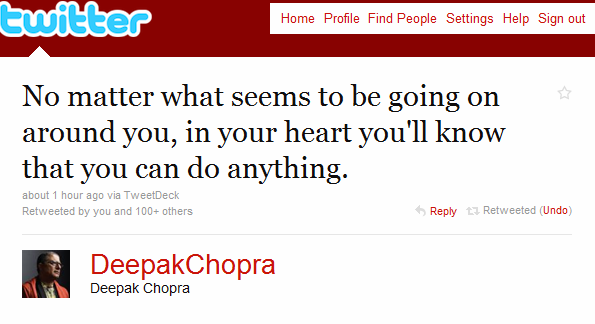
Well, actually the last sentence is a tweet from New Spirituality guru Deepak Chopra:


 (Online source)
Now here’s Word Faith preacher Joel Osteen from his book Your Best Life Now:

See your dreams coming to pass. You must conceive it and believe it is possible if you ever hope to experience it… To experience this immeasurable favor, you must rid yourself of that small-minded thinking and start expecting God’s blessings, start anticipating promotion and supernatural increase. You must conceive it in your heart and mind before you can receive it…. No matter what seems to be going on around you, in your heart you’ll know that you can do anything. (Online source)

Well, once again that last sentence is a tweet from Deepak Chopra, a guru long associated with the spurious spirituality of the new age of an expected Global religion:


(Online source)

I’m just sayin’…when the fallacious philosophies of pagan Eastern religions are also coming out of the mouths of men considered to be evangelical Christians there is certainly reason for concern. You think I overstate this; then you’d better re-think…real hard. I’ll warn you again; you’d best be aware of the new “big tent” version of Progressive Christianity [read: universalism] still being cobbled together by the likes of uber-liberal Harvey Cox along with his friend panentheist progressive/liberal theologian Dr. Philip Clayton, himself friends with Emerging Church guru Brian McLaren.

We know from Scripture that the enemy controling the deceitful spirits, using such as these, is already driving them all toward a Global religion anyway; and because of this, we will be seeing them cross pollinating more and more. You know, like I just showed you above. I think that the wise person will closely consider the following names below, which appear on the back cover, all endorsing the latest book by liberal/progressive theologian Harvey Cox The Future of Faith.

Note that you have a progressive/liberal Roman Catholic, the president of an obstensibly *cough* evangelical seminary, then three so-called Red Letter Christians—each of whom also adhere to the same new progressive Christian theology I mentioned above—and which guru McLaren began laying out in his latest book. Lastly you’ll again see Deepak Chopra, a pantheist pagan New Age mystic; and what do you know, they’re all enamored with this supposed “resurrection of a new global Christianity.”

And what do you suppose that they all have in common; I’ll tell you,  the personal practice of transcendental meditation in an altered state of consciousness. This pagan practice, which in a slightly sanitized version lightly sprayed with Christian terminology, is known to Christians who are lacking in discernment as Contemplative/Centering Prayer. You’d do well to prepare for some very rough spiritual waters, which unfortunately, lie dead ahead:

Harvey Cox is the most important liberal theologian of the last half century because he could see around corners…. The Future of Faith is, quite simply, a beautiful book and a Cox classic.
—E. J. Dionne Jr., author of Souled Out

The Future of Faith is insightful, provocative, and inspiring—I found myself uttering a hearty evangelical ‘Amen’ at many points!
—Richard Mouw, president of Fuller Theological Seminary and author of Calvinism in the Las Vegas Airport
This important book has not only helped me understand the past, present, future of this amazing phenomenon called Christianity . . . it has also motivated me to keep working to help make actual the possible future Cox envisions.
—Brian McLaren, author of A New Kind of Christian

The Future of Faith is a tour de force. As passionate and challenging as his classic, The Secular City, Cox’s new book invites the faithful, the skeptical, and the fearful intp a spirit-filled version of Christianity that can renew a hurting world.
—Diana Butler Bass, author of A People’s History of Christianity

Cox brings the eye of an historian and the heart of a theologian to explain where we’ve come from and where we’re going. The Future of Faith is an essential guide to that future.
—Jim Wallis, president of Sojourners and author of The Great Awakening

Harvey Cox has been a voice of both reason and faith in our cynical times. Now, he offers a fresh vision for the resurrection of a new global Christianity that will restore our faith both in ourselves and in the divine.
—Deepak Chopra, author of Jesus: A Story of Enlightenment
Just so you’ll now have all of this in its proper perspective, when a pantheist proponent of New Spirituality aka New Age like Deepak Chopra can sign on to your “big tent” supposed “resurrection of a new global Christianity,” then it’s safe to say that you’ve officially departed from anything even remotely resembling the historic, orthodox, Christian faith.

See also:

STEVEN FURTICK CALLS JOEL OSTEEN GREAT MAN OF GOD
TRANSFORMING CHRISTIANITY THROUGH EASTERN-STYLE MEDITATION
USING CONTEMPLATIVE/CENTERING PRAYER AS “CHRISTIAN” MEDITATION

(HT: Apprising Ministries)

Tuesday, August 3, 2010

Christian or Christ-follower?


From Lighthouse Trails Research


Christian or Christ-follower. It’s a distinction that is being made more and more today, and often the latter term, Christ follower, is replacing the former term, Christian. Even many Christian leaders are making the switch. But just what does it mean? Emerging church leader, Erwin McManus says his “goal is to destroy Christianity as a world religion and be a recatalyst for the movement of Jesus Christ.” In McManus’ book, The Barbarian Way, he talks about being “awakened” to a “primal longing that … waits to be unleashed within everyone who is a follower of Jesus Christ.” McManus says that the “greatest enemy to the movement of Jesus Christ is Christianity [i.e., Christians].” A video series on YouTube.com called “Christian No More” (by Christian Community Church) exemplifies this view by portraying those who call themselves Christians as shallow church-goers who wear suits and ties, have Christian bumper stickers on their cars and prefer the King James Version. This belittling video is evidence that it is increasingly more popular to call oneself a Christ follower rather than a Christian.

Interestingly, most of the leaders who seem to be downplaying the name Christian and promoting the appropriation of the term “Christ follower” are contemplative spirituality proponents. One contemplative advocate, Rick Warren, had the term throughout his former pastors.com website. Lee Strobel refers to it in his book Case for Christ (Student Edition), and Wesleyan pastor David Drury has a Christ-Follower Pop Quiz on his web site to help determine if you are really a “Christ Follower.”

This theme of anti-”Christian” sentiment is not going to disappear any time soon. In emerging church leader and labyrinth promoter Dan Kimball’s book called, “They Like Jesus, But Not the Church,” the idea is that you can go for Jesus, but you don’t have to identify yourself as a Christian or part of the Christian church. This concept spills over into some missionary societies too, where they teach people from other religions that they can keep their religion, just add Jesus to the equation. They don’t have to embrace the term “Christian” (see The New Missiology).

So what’s the problem? So what if you want to be a Christ follower instead of a Christian. Well, the problem, when identified, will show you why the Spiritual Formation movement (which is promoted by Purpose Driven, Willow Creek, the emerging church, etc) is so dangerous and misleading.

Let us explain. If you have researched the teachings of contemplative authors, you may have noticed a common message. That message says: If you want to be like Christ, then practice these certain disciplines and you can be like Him. Chuck Swindoll bought into this when he wrote his book, So You Want to Be Like Christ: Eight Essential Disciplines to Get You There. But Swindoll exalts one particular discipline – the silence. In fact, he goes so far as to say you can’t become a deep, meaningful Christian without it. Beth Moore, in the pro-contemplative film, Be Still, says: “[I]f we are not still before Him [God], we will never truly know to the depths of the marrow of our bones that He is God. There’s got to be a stillness.” And this is what contemplatives teach. The one common thread woven throughout spiritual formation teachings is that the silence and being a Christ follower are practically synonymous. You can’t have one without the other. And of course, this silence is induced through meditative practices such as centering prayer, lectio divina, etc.

So what we are witnessing is countless teachers, authors and leaders telling people they can become like Richard Foster teaches that anyone, not just believers, can practice contemplative prayer and become like Christ. Christ through a method that can be learned.

Now here lies the difference between a Christian and a Christ-follower. A person who is truly born-again has Jesus Christ indwelling him. Jesus lives inside that person. And it is His life in him or her that gives the power to become progressively more like Him (sanctification), as Paul said in his address to Corinthian Christians: “But we all, with open face beholding as in a glass the glory of the Lord, are changed into the same image from glory to glory, even as by the Spirit of the Lord” (II Corinthians 3:18). The believer draws his strength and power from Jesus Christ (who indwells him), and he realizes his salvation and any good thing in him is from Christ; as the Scripture says: “Not of works, lest any man should boast” (Ephesians 2:9).

But being born again or having the indwelling of Jesus Christ is not a prerequisite for the Christendom of today. Spiritual formation can be practiced by anyone. Jesus becomes a model or an example who can be followed and mimicked. For example, Ken Blanchard, says Jesus is a perfect model to follow. That’s why he talks so much about leading like Jesus would lead. But Blanchard has shown time and again that he believes meditation is a key factor in becoming like Jesus.

While Jesus was and is a model, that wasn’t His primary mission. And when people refer to Him as a model, it is often because they see Him as a model for higher consciousness rather than the unique Son of God, Emmanuel (God with us) who came to die for us and be our Savior. And that’s what you find across the board in contemplative writings. Contemplative icons Thomas Merton and Henri Nouwen saw Jesus in this manner. This is why Nouwen said it disturbed him when he heard people say Jesus was the only way. He said it was his mission to help people find his or her own way to God (see Sabbatical Journey). That’s also why he saw India as a source for many spiritual “treasures” for the Christian. 1 In an eastern religion like Buddhism, Buddha was a model where his followers were imitators of him. But in Christianity the Spirit of Christ indwells us through faith. So Jesus becomes more than a model; He is a living presence in us. “But without faith it is impossible to please him: for he that cometh to God must believe that he is, and that he is a rewarder of them that diligently seek him” (Hebrews 11:6).

This is actually the heart of the whole spiritual formation movement. It supposedly teaches you how to be like Christ, but the power to do this doesn’t come from Jesus Christ living in you (in fact that isn’t a requirement, according to Richard Foster) – but the power to change has to come from somewhere. Where? It comes from meditation! So anyone at all, from any walk of life, from any religion, can be a “Christ follower.” But this does not mean they have Jesus Christ in them. The contemplative prayer movement is misguiding millions into believing that if they practice certain disciplines they can be like Christ, thus securing their spiritual well being. They may come to believe that they have a christ consciousness and are Christ like, yet they do not have the actual power of Christ within. That power can only come from the indwelling presence of the Holy Spirit.

But as many as received him, to them gave he power to become the sons of God, even to them that believe on his name (John 1:12).

For I am not ashamed of the gospel of Christ: for it is the power of God unto salvation to every one that believeth; to the Jew first, and also to the Greek (Romans 1:16).

For the preaching of the cross is to them that perish foolishness; but unto us which are saved it is the power of God (I Corinthians 1:18).

This know also, that in the last days perilous times shall come … Having a form of godliness, but denying the power thereof” (II Timothy 3:1,5).

The man who virtually wrote the book on the subject (Centering Prayer), Basil Pennington, made the point of what we are trying to say when he penned these words:
 
It is my sense, from having meditated with persons from many different [non-Christian] traditions, that in the silence we experience a deep unity. When we go beyond the portals of the rational mind into the experience, there is only one God to be experienced.

Another major contemplative promoter stated:

The new ecumenism involved here is not between Christian and Christian, but between Christians and the grace of other intuitively deep religious traditions.–Tilden Edwards

These two men have both been leaders of the contemplative prayer movement for decades. And it is important to note that evangelical leader Richard Foster endorsed Edwards’ book, Spiritual Friend, from which this last quote came (see back, Celebration of Discipline). Both Pennington and Edwards would call themselves Christ followers, following in the same spiritual path as Jesus Christ followed. But as you can see, both Pennington and Edwards do not accept the view that believing the gospel is a vital prerequisite for having a relationship with the living God. Otherwise they would not have said the above. With this mindset, the message of the cross is rendered useless. And so the question that we must ask ourselves is this: Will we, who have Jesus Christ living in us, call ourselves Christians? Let those of us who name the name of Christ, stand and say, yes, we will be called Christians.

For a complete analysis and documentation of contemplative spirituality and its infiltration into Christendom, we encourage you to read A Time of Departing.

Spiritual Gifts


By Mike Ratliff

And he gave the apostles, the prophets, the evangelists, the shepherds and teachers, to equip the saints for the work of ministry, for building up the body of Christ, until we all attain to the unity of the faith and of the knowledge of the Son of God, to mature manhood, to the measure of the stature of the fullness of Christ, so that we may no longer be children, tossed to and fro by the waves and carried about by every wind of doctrine, by human cunning, by craftiness in deceitful schemes. (Ephesians 4:11-14 ESV)

There is little doubt that there are some in leadership positions in the visible church that are there because of their natural abilities rather than the fact that God has gifted them to lead His people. If the latter were the case, they would not be leading their followers into apostasy as the passage I placed at the top of this post clearly states. Those gifted by God to be true leaders in His Church have the role and responsibility to do what? They are to equip the saints for the work of ministry, for building up the body of Christ, until we all attain to the unity of the faith and of the knowledge of the Son of God, to mature manhood, to the measure of the stature of the fullness of Christ. Why?

It is so that we may no longer be children, tossed to and fro by the waves and carried about by every wind of doctrine, et cetera. Meditate on that my brethren then compare it with the apostate teaching such as Spiritual Formation, which is just another term for transcendental meditation, which is not Christian, but Eastern Mysticism. Along with that, there are all forms of universalism and Christian liberalism being taught right now being called Christianity and it is from these very things that the true called and gifted Christian leader is to equip those under his care to learn to turn from and not be deceived by their lies.

The Apostle Paul wrote about Spiritual Gifts in three of his Epistles. One I placed at the top of this post. The others are Romans and 1 Corinthians.

Having gifts that differ according to the grace given to us, let us use them: if prophecy, in proportion to our faith; if service, in our serving; the one who teaches, in his teaching; the one who exhorts, in his exhortation; the one who contributes, in generosity; the one who leads, with zeal; the one who does acts of mercy, with cheerfulness. (Romans 12:6-8 ESV)

To each is given the manifestation of the Spirit for the common good. For to one is given through the Spirit the utterance of wisdom, and to another the utterance of knowledge according to the same Spirit, to another faith by the same Spirit, to another gifts of healing by the one Spirit, to another the working of miracles, to another prophecy, to another the ability to distinguish between spirits, to another various kinds of tongues, to another the interpretation of tongues. (1 Corinthians 12:7-10 ESV)

And God has appointed in the church first apostles, second prophets, third teachers, then miracles, then gifts of healing, helping, administrating, and various kinds of tongues. (1 Corinthians 12:28 ESV)

In the passage I placed at the top of this post, Ephesians 4:11-14, we see that God gave apostles, prophets, evangelists, shepherds, and teachers. We also see why He gave them. Compare this with these three passages. Of course, the context is different in each passage because Paul was explaining something unique, but if we look at all four of these passages together we get a clear picture that it is God who gifts His people to be His leaders. He gives the leaders the gifts they need to obey Him whatever role He assigns them. These gifts differ according to the grace given to each recipient which is actually the manifestation of the Spirit for the common good. God has appointed in the Church what is needed. If we see shipwreck all over the visible church then what must we deduce from this? Are people misusing their gifts? Are God’s gifts not enough?

No, God’s Church is quite healthy. The visible church is not. This is the combination of the counterfeit church and the real Church. The reason apostasy appears to be so rampant is that the counterfeit part has grown so much larger and more visible. There are still God’s people who have not bowed the knee to Baal nor sacrificed their children to Molech.

Those of us truly in Christ must continually turn from evil as we continually turn to our Lord and serve Him in all we do. In this, God will use us and our gift(s) as He sees fit. I was in a discussion the other day with some friends and we became amused because it became apparent that we were all pretty much a bunch of what the visible church would classify as nobodies. However, we were the ones whom it appears God is using to shine His light of truth into the darkness because those well-known Christian leaders who should be leading the way are not doing it. Even if God does us me and my friends this way, I know that I am still a nobody in the Kingdom of God and my Saviour is Lord of All and all the glory goes to Him.

Soli Deo Gloria!

(HT: Possessing the Treasure)


Tuesday, March 9, 2010

Monvee - E-Harmony for your spiritual life

OneOne Radio featured a breakdown of the new program called Monvee in the March 8th broadcast. What is Monvee you ask? It is the newest program in the seeker sensitive/purpose driven spirituality that is marketed as the E-Harmony for your spiritual practices.

Once you give information, Monvee gives recommendations in four specific areas of spiritual growth that promises to allow you to grow spiritually according to how you are ‘wired’ (or as Rick Warren would put it, according to your S.H.A.P.E. these are:
  1. Your Mind
  2. Your Time
  3. Your Experiences
  4. Your relationships
In the founders Movee, he is recommended to practice both prayer from scripture as well as contemplative prayer. In other words, Monvee, like the seeker sensitive, purpose driven, and emergent christianity apostasy that is called evangelicalism today, we are told to integrate eastern mysticism and Roman Catholic practices in order to further spiritual growth and deepen our spiritual experience. The good news is that the person taking the Monvee will never be over loaded, because it is customized for the individual and what the individual wants or needs. The real good news is that the Monvee can communicate with the church, making the Saddleback Sam of the 90’s much easier to read, diagnose, and prepare services for. It becomes ME Church on steroids.

The makers of Monvee have replaced the role of the Holy Spirit in their lives, and the Bible as our instruction book in order to market custom made spirituality. This is neo-pelagianism of the worst kind that somehow you can follow a computer program and a bunch of suggestions to make you more spiritual and closer to God.

 As a believer, you do not need Monvee. Let me show you!
  1. Your Mind: Repent! Change your mind about who you are and who God is. Follow your mind with a change of direction away from sin and death, believing in the Lord Jesus Christ and trusting Him alone for your salvation. Then you will become a new creature in Christ (2 Cor 5:17) and by the grace of God, you can have a renewed mind (Romans 12:1-2) and walk according to the Spirit and not fulfill the lusts of the flesh (Romans 6:12-14).  Remember, you have the scripture, which is useful for all things that a believer needs for every good work (2 Timothy 3:16-17) and you have an open line to God in prayer because of the sacrifice of Jesus Christ. Not to mention the Holy Spirit, which has sealed you and will guide you in all truth (John 15,16,17)
  2. Your time: You now belong to God, and therefore are His temple. You have been bought with a price, so you will honor God with your body (1 Cor 6:20). You will use your time to glorify Him, making the most of every opportunity (Ephesians 5:15-16). After all, you are a living sacrifice (Romans 12:1) and you are a spiritual stone (1 Peter 2) and are to go about making spiritual sacrifices with your life. Remember, you are part of the universal body of Christ, and you have a role to play within it.
  3. Your Experiences: Remember, you are God’s workmanship created in Christ Jesus (Ephesians 2:10) to do good works. Therefore,  you honor God with your body as you do these things He has created you to do. All you need is time in the Word, in prayer, and perhaps words from other Christians as to how you can best impact the kingdom how God has made you. We all are commanded to follow Christ, and something every believer is to do is to share their faith (Mark 16:15, Acts 1:8, Matthew 28:18-20).
  4. Your relationships: We are also to be part of a local body of believers so that we can do our part both being built up and equipped, (Ephesians 4:11-14) and building up and equipping others according to our spiritual gifts (Galatians 5:22).
Do not waste your money, or your time on Monvee. Any true believer does not need it, and should be able to find the answers on how to go deeper within their Church, from their Pastor, the Word, and by the power of the Holy Spirit.

Wednesday, February 10, 2010

Be Killing Sin Or It Will Be Killing You


By Mike Ratliff

Or do you not know that the unrighteous will not inherit the kingdom of God? Do not be deceived: neither the sexually immoral, nor idolaters, nor adulterers, nor men who practice homosexuality, nor thieves, nor the greedy, nor drunkards, nor revilers, nor swindlers will inherit the kingdom of God. And such were some of you. But you were washed, you were sanctified, you were justified in the name of the Lord Jesus Christ and by the Spirit of our God. (1 Corinthians 6:9-11 ESV)


The 21st Century version of pop-Christianity is not doctrinally sound. That should not surprise us since those most of influence in it elevate human philosophy up to the highest esteem while looking at Orthodox Christianity and its solid biblical doctrines as passé or old-fashioned or something to be phased out to make room for what is culturally relevant. One of the components of this “pop-Christianity” consists of using cool buzzwords like “missional.” Within that paradigm, there are other cool buzzwords like “incarnational” and “Spiritual Formation.” I have yet to see a denominational or church group go down the path of a “missional” focus that does not also emphasize the necessity of being “incarnational” and that that must be preceded by a church-wide emphasis on Spiritual Formation. “Incarnational” is a buzzword that refers to a church becoming culturally relevant. It calls for its members to alter how everything is done in the church in order for those outside of it to not feel threatened so they will come in and become part of it. They attempt to make the church look just like the culture they are attempting to be part of. They are trying to fit the church in. A crucial step in doing this is Spiritual Formation in which the members go through spiritual disciplines in order to enhance their ‘spiritual maturity.’ This is focused on things like transcendental meditation, yoga, et cetera.


None of this is biblical. It is a drive to make churches be just like the world in order to be acceptable by it. As I grow in Christian maturity I find that I am being drawn into becoming more and more separate from the world, to remove those markers from my life that make me worldly or be like the world, to actually mortify or kill the sin my flesh desires. Christian maturity is a call to become more and more holy and that means separate from the ways and standards of this lost and dying world. Christians who are more mature should take on the role of those who disciple. That is, they should come along side the less mature believers God brings into their influence in order to lead them into something far superior to anything that would come from spiritually bankrupt ‘Spiritual Formation.’

One of the reasons that pop-Christianity has such a hold in our time is that the deterioration and erosion of solid discipleship through biblical exposition has become more and more prevalent over the last 100+ years. C.H. Spurgeon in the late 19th Century noted its rise as the Great Down-Grade Controversy. This has only gotten worse as man-focused religiosity has replaced Bible-focused and God-centered discipleship and evangelism. In our time, the greatest sin seems to be to cause offense. No one is willing to stand firm and be bold with God’s truth. Carefully read the passage I placed at the top of this post. Is that politically incorrect or what? Well, that is God’s truth. The Gospel is offensive because it calls all people sinners and completely unworthy of salvation. However, those called by God to believe are also called to live a life of repentance. That means that within the Lordship of Jesus Christ they learn to walk through their Sanctification in continual mortification of their sin. The Puritans understood this. However, as compromise has consumed the will of the Church with no one wanting to risk offending anyone, this sort of teaching is rare indeed.

At our salvation, God justified us, but that is a forensic declaration by God as He imputes Christ’s Righteousness to our account. However, other than our regeneration, which makes us spiritually alive in Christ, we still have the reality of sin within us that is keyed to our flesh. Hence, the work of sanctification in our lives becomes the key to true Spiritual Maturity in Christ. Since the vast majority of professing Christians are ignorant of what I am talking about here and see doctrinal words like Justification and Sanctification through ignorance, let us take a closer look at this work of sanctification that God does in each of His children.

Continue Reading 

You Might Also Like

Related Posts Plugin for WordPress, Blogger...