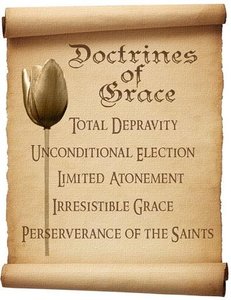
Showing posts with label Doctrines of Grace. Show all posts
Friday, July 22, 2011
The Gospel Is for Christians
By Justin Edwards
My family traveled to Georgia last week and as we were driving through Atlanta, I got a chance to listen to the Janet Medford Show. I was tuning in late to an interview with Mitchell Chase, author of The Gospel Is for Christians. I had never heard of him before, but this interview was excellent and I found myself "amening" throughout the conversation.
Having listened to the entire show a couple days ago, there's a couple of things I'd like to highlight.
Mitchell succinctly defined the Gospel as a "work of Christ on behalf of sinners to satisfy the wrath of God." I've also heard it recently said the Gospel is God saving us for Himself, by Himself, from Himself. Think about that for a moment. The plan of redemption, as Mitchell said, is not a Plan B for humanity. There is no Plan B. The plan of redemption is Plan A and always has been. It is not a reaction to fallen humanity, it is merely the unfolding of history according to God's eternal plan to save a people for Himself to glorify Him and enjoy Him forever.
The cross, therefore, is the centerpiece of redemptive history. God's redemptive purposes for mankind are centered on the cross, a work that was foreordained in eternity past according to the counsel of God's own will. Knowing this, how humbling is it then for His children to be the recipient's of the riches of His divine grace and mercy, to not only partake in the glories of the Kingdom in this life and the next, but to partake in the plan of redemption by being the vessels by which the Gospel of the Lord Jesus Christ is proclaimed to the ends of the earth.
The primary mission for the church is to proclaim this message of Good News. This is the responsibility of the hands and feet of the Body of Christ, namely you and I as individuals, to GO out and make disciples. While the Gospel is surely proclaimed from faithful pulpits preaching the whole counsel of God, the primary purpose of the pulpit is not evangelism. While it is acceptable to invite the lost to come to church with us (and we should), this is not a substitute for evangelism. No, Jesus said to GO. As we are shepherded, equipped, and prepared in the local church for evangelism (as we should be), our mandate is to take the message of Christ and Him crucified to the world. Church is a time of Christian fellowship, teaching, correction, exhortation, conviction, sanctification, and being stirred unto good works. But evangelism takes place outside of the church doors, where the darkness hides, the blind walk, and the wanderers navigate the wilderness of the world with no compass. Our mandate is to take the message of Hope to the hopeless, not depending on the corporate church to bare that responsibility as that is not the corporate church's primary responsibility - it is yours and mine.
How then do we become compelled to be faithful to the Great Commission? By truly understanding the Gospel in that it not only saves us from the bondage of sin and the wrath of God, but it gives us eternal life and changes us to be conformed to the Lord Jesus Christ. We are changed from being dead in our trespasses and sins into new creations walking in newness of life. When we are born again, we are awakened from the spiritual dead and given Life, namely Jesus Himself. Hopelessness is exchanged for an enduring Hope, condemnation is exchanged for Grace, wrath is exchanged for mercy, and love for the world is exchanged for love of the worthy and glorious Lamb of God.
That is what the world needs, and God has designed His plan of redemption in a manner to utilize His found sheep to call His lost sheep to repentance. He has blessed us with the mandate to proclaim the mercies of God against the backdrop of the wrath to come. Such sinners were we who have been showered with grace - how can we not be compelled to tell others the truth and glory of the Gospel of Christ that they would also be recipients of God's love, grace, and mercy?
I'm really looking forward to reading Mitchell Chase's book (you can purchase it here at Amazon and read reviews from Al Mohler, Tim Challies, and Tullian Tchividjian). In the meantime, I hope you take the time to listen to Janet Medford's interview with Mitchell as they cover other topics including repentance, the attributes of God, and the current condition of the visible church. The interview is covered in the first 20 minutes of the show's first segment: Janet Mefferd-7/14/2011-Hour 1-Janet Mefferd Radio Show
Posted by
Justin Edwards
at
11:36 AM
Labels:
Doctrines of Grace,
evangelism,
Gospel,
Great Commission,
redemption,
repentance,
salvation,
sovereign grace
Wednesday, July 13, 2011
The Sovereignty of God Bible Test
By Justin Edwards
Blessed be the God and Father of our Lord Jesus Christ, who has blessed us in Christ with every spiritual blessing in the heavenly places, 4 even as he chose us in him before the foundation of the world, that we should be holy and blameless before him. In love 5 he predestined us for adoption as sons through Jesus Christ, according to the purpose of his will, 6 to the praise of his glorious grace, with which he has blessed us in the Beloved. - Ephesians 1:3-6
Thanks to John Samson for posting the following "Sovereignty Bible Test", which cleverly emphasizes the sovereignty of God in all things, most especially our salvation. The origins of this quiz is unclear, but I'm thankful it is making its rounds across the internet. Enjoy!
Eph 1:11 – “him (God) who works all things according to the counsel of his will.”
1. If God works all things after the counsel of His will, how much does He work to the will of you, me, Satan, etc.?
A. None.
B. 20%
C. 50%
D. 85%
Isaiah 14:24 The Lord of hosts has sworn: “As I have planned, so shall it be, and as I have purposed, so shall it stand.”
2. How much of what He purposes to come to pass, doesn’t?
A. All of His purposes will come to pass
B. Some of His purposes will not come to pass
C. A few of His purposes will not come to pass
D. A lot of His purposes will not come to pass
Romans 8:29, 30 For those whom he foreknew he also predestined to be conformed to the image of his Son, in order that he might be the firstborn among many brothers. And those whom he predestined he also called, and those whom he called he also justified, and those whom he justified he also glorified.
3. How many do you think have been called, justified, or glorified that He did not first foreknow or predestinate?
A. Write in your answer: ___________________
John 10:14, 15 I am the good shepherd. I know my own and my own know me, just as the Father knows me and I know the Father; and I lay down my life for the sheep.
4. Where does this scripture say that Jesus laid down his life for the sheep and the goats
A. It doesn’t
B. It doesn’t, but I just know He meant the goats, too
John 6:65 “no one can come to me unless it is granted him by the Father.”
5. How many come to Jesus that were not first given to Him by the Father?
A. 0
B. 5,000
C. 5,000,000
D. 10,000,000
John 6:37 All that the Father gives me will come to me
6. How many that the Father gave Him will not come to Him?
A. Two
B. A couple of thousand
C. A couple of million
D. Trick question, it says they will all come to Him
John 10:28, 29 I (Jesus) give them (My true sheep) eternal life, and they will never perish, and no one will snatch them out of my hand. My Father, who has given them to me, is greater than all, and no one is able to snatch them out of the Father’s hand.
7. How many sheep do you think have been snatched from either God’s or Jesus’ hands?
A. None
B. 50,000
C. 500,000
D. 1,000,000
Rev. 13:8 and all who dwell on earth will worship it, everyone whose name has not been written before the foundation of the world in the book of life of the Lamb who was slain.
Rev. 20:15 And if anyone’s name was not found written in the book of life, he was thrown into the lake of fire.
8. Considering this, and other related scripture, God having to blot out a name from the book of life would mean:
A. God makes mistakes.
B. Some have been snatched from Jesus’ hands?
C. God didn’t know that some of His sheep were really goats.
D. None of the above.
Matt 13: 10, 11 Then the disciples came and said to him, “Why do you speak to them in parables?” And he answered them, “To you it has been given to know the secrets of the kingdom of heaven, but to them it has not been given.
9. Jesus himself declared that one of the reasons why He spoke in parables was that the truth might be concealed from whom it was not intended. Is this fair?
A. No.
B. Yes.
C. Who are we to question God?
D. I’m going to pretend I didn’t see that verse.
Romans 8:28 we know that for those who love God all things work together for good, for those who are called according to his purpose.
10. How many things do not work for the good of those who love God?
A. 10% of all things
B. 40% of all things
C. 85% of all things
D. Trick question, the Bible says all things work for the good of those who love Him
Mark 14:30 And Jesus said to him, “Truly, I tell you (Peter), this very night, before the rooster crows twice, you will deny me three times.”
11. (A) Could Peter not have denied Jesus three times before the cock crowed twice?
Answer here: ____________________________
11. (B) Did Jesus coerce Peter to deny him, or did Peter do it of his own heart and will?
Answer here: ____________________________
Exodus 4:11 [God Himself asks the rhetorical question] “Who has made man’s mouth? Who makes him mute, or deaf, or seeing, or blind? Is it not I, the Lord?”
12. Is this fair?
A. Yes.
B. No.
C. Who are we to question God?
D. I’m going to pretend this isn’t in the Bible
OK. the test is over, but in truth, the whole of life is something of a test as we learn just how Sovereign God is in all things and we learn to trust in His loving care.
Did the test make you think about just how Sovereign God truly is? Hope so.
“In Him we live and move and have our being.” (Acts 17:28)
Posted by
Justin Edwards
at
10:18 AM
Labels:
Calvinism,
Doctrines of Grace,
sovereign grace,
Sovereignty
Monday, June 6, 2011
Calvinism: "Salvation Is of the Lord"
From The Grace Community Blog on an excerpt taken from a sermon titled “A Defense of Calvinism” by C. H. Spurgeon
Calvinism: “Salvation is of the Lord”
That is just an epitome of Calvinism; it is the sum and substance of it. If anyone should ask me what I mean by a Calvinist, I should reply, “He is one who says, Salvation is of the Lord.” I cannot find in Scripture any other doctrine than this. It is the essence of the Bible. “He only is my rock and my salvation.” Tell me anything contrary to this truth, and it will be a heresy; tell me a heresy, and I shall find its essence here, that it has departed from this great, this fundamental, this rock-truth, “God is my rock and my salvation.” What is the heresy of Rome, but the addition of something to the perfect merits of Jesus Christ—the bringing in of the works of the flesh, to assist in our justification? And what is the heresy of Arminianism but the addition of something to the work of the Redeemer?
Every heresy, if brought to the touchstone, will discover itself here. I have my own private opinion that there is no such thing as preaching Christ and Him crucified, unless we preach what nowadays is called Calvinism. It is a nickname to call it Calvinism; Calvinism is the gospel, and nothing else. I do not believe we can preach the gospel, if we do not preach justification by faith, without works; nor unless we preach the sovereignty of God in His dispensation of grace; nor unless we exalt the electing, unchangeable, eternal, immutable, conquering love of Jehovah; nor do I think we can preach the gospel, unless we base it upon the special and particular redemption of His elect and chosen people which Christ wrought out upon the cross; nor can I comprehend a gospel which lets saints fall away after they are called, and suffers the children of God to be burned in the fires of damnation after having once believed in Jesus. Such a gospel I abhor.
Monday, April 11, 2011
Why Every Calvinist Should Be a Premillennialist
By Justin Edwards
If you want to get the future right, you've got to get Israel right and you've got to get God's sovereign electing purpose right. - John MacArthur
I am currently going through a series from John MacArthur titled, Why Every Calvinist Should Be a Premillennialist, and wanted to go ahead and share it with you (HT: Defending. Contending). I am halfway through Part 4 and am finding the material to be richly informative of the amillennial view that the Church has replaced Israel to receive her promises from God as Israel has forfeited her rights to those promises through apostasy. Parts 1 and 2 provide great introductions to the series, and Parts 3 and 4 have been rich in Scripture giving key evidence that God's promises to Israel are eternal and not dependent upon her faithfulness to God.
MacArthur poses 5 questions to be answered in this series:
1. Is the Old Testament amillennial?
2. Were the Jews of Jesus' day amillennial?
3. Was Jesus amillennial?
4. Were the Apostles who wrote the New Testament and those associates of the Apostles amillennial?
5. Were the early church fathers amillennial?
Leading up to these questions, MacArthur gives the following brief explanation and quotes Horatius Bonar, a 19th Century Scottish-reformed theologian, in his work titled, Prophetic Landscapes. Keep in mind Bonar penned this is 1847:
So to say it simply, to hold the view of amillennialists, called replacement theology, that the church replaces Israel in the promises of God, Israel as God's Elect is no longer God's Elect, cancelled out, to come up with this idea that there therefore is no real earthly Kingdom to fulfill those promises and that they are fulfilled in the spiritual life of the church both now and in heaven, you have to deny the nature of divine sovereign election. You have to basically say that when God called Israel His Elect, and when God gave them unconditional, unilateral, irrevokable promises, He didn't keep them, or He doesn't keep them, so that election doesn't mean permanent election, it might be temporary as in the case of Israel.
I don't know anybody who believes in the doctrine of election who thinks its temporary with the elect angels, or temporary with the elect Son or temporary with the elect church, so this has to be a category invented to accommodate replacement theology. The second thing that has to happen is, you cannot interpret Scripture in the normal meaning, the normal sense in which it is written both in the Old Testament and the New Testament because clearly in both testaments promises are made to Israel. Therefore Israel doesn't mean Israel, a thousand years doesn't mean a thousand years, reigning in Jerusalem doesn't mean reigning in Jerusalem, it means something else...something not apparent in any normal interpretation of the language. So you can see there are some extremes here in trying to make this work theologically when you have to reinvent the doctrine of election which is so sacred to us and when you have to change the normal meaning of the language.
Now, I want to having said that, say this, that throughout history there have been some in Reformed circles of great note who didn't buy this. I am particularly, as you probably known, drawn more to Scottish Reformed theology than I am to Dutch Reformed theology. And one of my favorite Scots in the area of theology is Horatius Bonar. He's a nineteenth century preacher, Scottish preacher and theological writer. In 1847 he wrote prophetic landmarks and he took a position very different from his Reformed friends, very different. He was always a strong advocate of the doctrines of sovereign grace. He was always a strong advocate of the doctrine of election. He affirmed as well that election was forever and therefore affirmed the primacy of the destiny of the Jews in the scheme of eschatology. So he was going against the grain of his day and his compatriots. This is what Bonar wrote in 1847: "The prophecies concerning Israel are the key to all the rest. True principles of interpretation in regard to them will aid us in disentangling and illustrating all prophecy. False principles as to them...that is Israel...will most thoroughly perplex and overcloud the whole Word of God," end quote. And that's right back to what I said and when I said it I hadn't yet found Bonar's comment. He says you can't get eschatology right if you don't get Israel right.
He further wrote of his conviction as to biblical clarity on this matter. And his language is so magnificent that it needs to be thoughtfully repeated. So let me read to you what Bonar wrote in 1847. "I am one of those who believe in Israel's restoration and conversion, who receive it as a future certainty, that all Israel shall be gathered and that all Israel shall be saved. As I believe in Israel's present degradation, so do I believe in Israel's coming glory and preeminence. I believe that God's purpose regarding our world can only be understood by understanding God's purpose as to Israel." Now remember, this is a time long before they had ever been gathered back into their land.
Source
He went on to say, "I believe that all human calculations as to the earth's future, whether political or scientific, or philosophical, or religious, must be failures if not taking for their data or basis God's great purpose regarding the latter day standing of Israel. I believe that it is not possible to enter God's mind regarding the destiny of man without taking as our key or our guide His mind regarding that ancient nation, that nation whose history so far from being ended or nearly ended is only about to begin." He went on to say this, "He only to whom the future belongs can reveal it. He only can announce the principles on which that future is to be developed. And if He set Israel as the great nation of the future and Jerusalem as the great metropolis of earth, who are we that without philosophy of science we should set aside the divine arrangements and substitute for them a theory of man? Human guesses concerning the future are the most uncertain of all uncertainties and human hopes built upon these guesses are sure to turn out the most disappointing if not the most disastrous of all failures. I believe that the sons of Abraham are to re-inherit Palestine and that the forfeited fertility will yet return to that land, that the wilderness and the solitary places shall be glad for them, and the desert will rejoice and blossom as the rose. I believe that meanwhile Israel shall not only be wanderers, but that everywhere only a remnant, a small remnant shall be saved. And that it is for the gathering in of this remnant that our missionaries go forth. I believe that these times of ours are the times of the Gentiles and that Jerusalem and Israel shall be trodden down of the Gentiles till the times of the Gentiles be fulfilled. I believe that the completion of what the Apostle calls the fullness of the Gentiles will be the signal for the judgments which are to usher in the crisis of earth's history and the salvation of Israel and the long-expected Kingdom."
Why did he believe that? Because that's exactly what the Bible says.
Indeed. You can download each message below or go to the original link here: Why Every Calvinist Should Be a Premillennialist
Why Every Calvinist Should Be a Premillennialist, Part 1
Why Every Calvinist Should Be a Premillennialist, Part 2
Why Every Calvinist Should Be a Premillennialist, Part 3
Why Every Calvinist Should Be a Premillennialist, Part 4
Why Every Calvinist Should Be a Premillennialist, Part 5
Why Every Calvinist Should Be a Premillennialist, Part 6
Posted by
Justin Edwards
at
10:51 AM
Labels:
amillennialism,
Calvinism,
dispensationalism,
Doctrines of Grace,
Endtimes,
Israel,
premillenialism,
prophecy
Saturday, April 9, 2011
John 3:16 - "Whosoever" and "the World"
By Justin Edwards
Tradition tells us that God so loved the world that He gave His only begotten Son, that whosoever will believe in Him will not perish but have everlasting life. However, this is what the Scripture says:
KJV: For God so loved the world, that he gave his only begotten Son, that whosoever believeth in him should not perish, but have everlasting life.
ESV: For God so loved the world, that he gave his only Son, that whoever believes in him should not perish but have eternal life.
If you are open to reconsider tradition and learn what this most popular Bible verse actually means, then please take a moment to watch the following videos from Jim McClarty and James White. You might be surprised that what you thought to be true is not, and this Scripture actually fits well in reformation theology. In short, John 3:16 speaks of those who believe or "all the believing ones" will not perish, not that anyone can believe.
You may also find this brief article from John Samson also beneficial: Understanding John 3:16
Wednesday, March 23, 2011
What Is Wrong with NON-Lordship Salvation? - Part 2
By Justin Edwards
The time is fulfilled, and the kingdom of God is at hand; repent and believe in the gospel. - Mark 1:15
Dr. Andy Woods of Sugar Land Bible Church was recently featured on the Bible Prophecy Blog with his article titled, What Is Wrong with Lordship Salvation? He provided 5 arguments for why lordship salvation is wrong, and as I informed you in the introductory article, What Is Wrong with NON-Lordship Salvation? - Part 1, I will be addressing each of his flawed arguments in a series to be sure to cover all of Dr. Woods' errors in a thorough manner. My aim is to provide clear evidence from Scripture for why "lordship salvation" is nothing short of the Gospel of the Lord Jesus Christ, to clear up confusion for those perplexed by Dr. Woods' article, to give clarity of the lordship salvation doctrine for those who have been deceived by teachings such as that provided by Dr. Woods, and to edify the Body of Christ and encourage the brethren to boldly proclaim the unadulterated biblical Gospel. I pray this endeavor will honor and bring glory to my God and King, for whom I owe my life as a humble servant because of His love and sovereign grace (Romans 12:1).
Part 2 - Saving Faith
Dr. Woods' position truly hinges on his first argument, and likewise crumbles under it. Because he and many others like him in the evangelical church hold to a low view of God, which is to say that man holds greater sovereignty over himself than the Omnipotent Creator, it is difficult for them to comprehend God's work in our salvation. Moreover, Dr. Woods inherently charges those who believe in the unadulterated Gospel of the Lord Jesus Christ as preaching another gospel with such statements as,
Lordship Salvation changes the very heart of the Gospel, which only requires a child-like faith.
My challenge to Dr. Woods and every person reading this article who agrees with his assertion of lordship salvation - are you prepared to declare men and women who adhere to "lordship salvation" as heretics? After all, if lordship salvation "changes the very heart of the Gospel", would that not be another gospel? Would this other gospel not be accursed according to Galatians 1:8-9? Are you prepared to mark godly men such as Jonathan Edwards, Charles Spurgeon, Martin Lloyd-Jones, George Whitefield, John Bunyan, A.W. Pink, B.B. Warfield, John Knox and the Puritans, J.C. Ryle, Leonard Ravenhill, Steven Lawson, John MacArthur, Ray Comfort, Al Mohler, C.J. Mahaney, Ray Comfort, Paul Washer and many other stalwarts of the faith as heretics? Because I tell you, these men believe in none other than the Lordship of Christ and our surrender to Him at salvation. Or perhaps you were a bit irresponsible with your words, Dr. Woods? If you truly believe these men, who represent historical Christian orthodoxy, are preaching a message that is contrary to the heart of the Gospel, do you stand by these implications? Why or why not?
Dr. Woods continues in his first argument:
There are probably somewhere between 150 to 200 New Testament passages which singularly condition a lost person’s salvation upon belief alone in Christ (John 3:16; 6:28-29; Acts 16:31; Rom 1:16, etc...). Belief is a synonym for faith or confidence or trust in God’s provision. The moment a lost person exercises trust in Christ is the moment he is saved.
So the devils are then saved, Dr. Woods? If all saving faith requires is to believe, then what of these devils who believe there is one God and tremble (James 2:19)? Clearly, it is more than just intellectual assent to a list of facts of who Christ is and what He has done. After all, faith without works is dead (James 2:20). Therefore, it is the type of belief one has that results in saving faith, and it is not of ourselves lest we should boast (Ephesians 2:8-9).
Dr. Woods continues,
Why has God made salvation so simple? God has designed salvation as a free gift (Rom 4:4). If there were some human action to be performed beyond belief then salvation becomes something that we do rather than what God does. Such a human insertion reduces salvation’s free gift status by making it something we earn. In other words, under the Lordship Salvation model, surrender or commitment becomes a work that one does to earn salvation despite the fact that the Scripture is clear that salvation is not by works (Eph 2:8-9; Isa 64:6). Also, God has specifically designed salvation so that the principle of human boasting is eliminated (Rom 3:27; 4:2). Yet, if the unsaved could do anything to merit salvation beyond simple belief, such as commit or surrender, then he has contributed to the salvation process and thus has something to boast over. God cannot allow this to happen given His aversion to pride of any sort.
Dr. Woods has it backwards in terms of working and boasting. Because a position such as Dr. Woods' reduces belief to a human work, it is no wonder there is an attempt to reduce faith to simple intellectual belief. By adding any type of commitment or repentance to this type of belief, from their perspective, it adds works to salvation. And I would agree with them if salvation was indeed left up to man's own choosing or natural ability to choose God in faith.
But, as we were completely spiritually dead in our trespasses (Ephesians 2:1) and blinded by the god of this world (2 Corinthians 4:4), it is only by the absolute sovereign grace of God who shines His light in us, thus breaking the power of darkness and lifting the veil from our blinded eyes (2 Corinthians 4:6), that we are enabled to believe with conviction. God must perform open-heart surgery on us that we would love Him with all of our mind, soul, heart, and strength (Deuteronomy 30:6) , and when He does, we will come to the cross! (John 6:37, 17:2) Our salvation, therefore, is wrought out of the will of God, not man (John 1:13, Romans 9:16), because He is rich in mercy (Ephesians 2:4-5) and wills to bring glory to Himself through His perfect plan of redemption (Ephesians 1:3-14).
Having established that salvation is of the Lord (Jonah 2:9; 1 Corinthians 1:29-31), and it is impossible for natural man to discern the things of God (1 Corinthians 2:14, Romans 8:7-8), we may now move forward in defining saving faith.
The simplest definition of saving faith is:
Saving faith is trusting that Jesus is both God and Lord (John 20:28), who alone has the power to forgive sins (Luke 5:24, John 8:58), has also the power to save us from our sins (Romans 5:10) and destroy the dominion of sin over us (Romans 6:5-11; 1 John 3:8). So yes, I agree with Dr. Woods that the moment a person exercises trust in the Lord Jesus Christ and His finished work on the cross, he is saved because he is justified, sanctified, and washed by the blood of Jesus (1 Corinthians 6:11, 1 John 1:7). But this is not mere intellectual assent to a list of facts, it is a faith that actually trusts that God can do what He promises to do - that is, to save us from His own wrath and to save us from the bondage of our sin.
In closing his first argument, Dr. Woods tells us,
Lordship Salvation perverts this divine order by making salvation something we do for God rather than something He does for us. It is Christ who saves us rather than our surrender or commitment to Him.
No, Dr. Woods, your misconception about lordship salvation perverts this divine work of God. And about God doing something for us - everyone single person reading this article and every single person who has ever carried oxygen in their lungs deserves the just punishment of eternal hell (Romans 3:23, 6:23). We have all broken God's Law, therefore none of us are righteous (Romans 3:10). The Sovereign Lord would still be good and would still be just if He saved none of us and we all perished in hell for our iniquities. However, before the foundation of the world, He chose to redeem a people for Himself through His own Son because of His great mercy (1 Peter 1:2, 20-21). So it is completely and absolutely, from start to finish, something He does for us. He chose a people for Himself, He purchased them with His blood, and He reconciled them through the Spirit - despite our wickedness and to the praise of His own glory.
The reason why faith commits, surrenders, and obeys is because faith is a gift and a work of God in us. He changes our heart and our attitude, which gives us the desire to submit to His will and enables us to comply. The childlike faith Dr. Woods mentioned is precisely what we must have in order to receive the gift of eternal life (Matthew 18:3). A child's faith is humble and submits to authority. In humility, they are able to be taught and obey the commands of authority. Likewise, without this humble submission to the authority of Christ, no one will see the Kingdom of God.
The following excerpt is from Charles Spurgeon, the prince of preachers, who delivered this divine message on June 13th, 1862 titled, Faith and Repentance Inseperable (transcript). This must-listen sermon can be downloaded at Sermonaudio. Here, Spurgeon warns of a type of belief that does not save (paragraphs created for easier reading):
Faith means trust in Christ. Now, I must again remark that some have preached this trust in Christ so well and so fully, that I can admire their faithfulness and bless God for them; yet there is a difficulty and a danger; it may be that in preaching simple trust in Christ as being the way of salvation, that they omit to remind the sinner that no faith can be genuine but such as is perfectly consistent with repentance for past sin; for my text seems to me to put it thus: no repentance is true but that which consorts with faith; no faith is true but that which is linked with a hearty and sincere repentance on account of past sin.
So then, dear friends, those people who have a faith which allows them to think lightly of past sin, have the faith of devils, and not the faith of God's elect. Those who say, "Oh, as for the past, that is nothing; Jesus Christ has washed all that away"; and can talk about all the crimes of their youth, and the iniquitous of their riper years, as if they were mere trifles, and never think of shedding a tear; never feel their souls ready to burst because they should have been such great offenders—such men who can trifle with the past, and even fight their battles o'er again when their passions are too cold for new rebellions—I say that such who think sin a trifle and have never sorrowed on account of it, may know that their faith is not genuine.
Such men as have a faith which allows them to live carelessly in the present who say, "Well, I am saved by a simple faith"; and then sit on the ale-bench with the drunkard, or stand at the bar with the spirit-drinker, or go into worldly company and enjoy the carnal pleasures and the lusts of the flesh, such men are liars; they have not the faith which will save the soul. They have a deceitful hypocrisy; they have not the faith which will bring them to heaven.
And then, there be some other people who have a faith which leads them to no hatred of sin. They do not look upon sin in others with any kind of shame. It is true they would not do as others do, but then they can laugh at what others commit. They take pleasure in the vices of others; laugh at their profane jests, and smile at their loose speeches. They do not flee from sin as from a serpent, nor detest it as the murderer of their best friend.
No, they dally with it; they make excuses for it; they commit in private what in public they condemn. They call grave offences slight faults and little defalcations; and in business they wink at departures from uprightness, and consider them to be mere matters of trade; the fact being that they have a faith which will sit down arm-in-arm with sin, and eat and drink at the same table with unrighteousness. Oh! if any of you have such a faith as this, I pray God to turn it out bag and baggage. It is of no good to you; the sooner you are cleaned out of it the better for you, for when this sandy foundation shall all be washed away, perhaps you may then begin to build upon the rock.
My dear friends, I would be very faithful with your souls, and would lay the lancet at each man's heart. What is your repentance? Have you a repentance that leads you to look out of self to Christ, and to Christ only? On the other hand, have you that faith which leads you to true repentance; to hate the very thought of sin; so that the dearest idol you have known, whatever it may be, you desire to tear from its throne that you may worship Christ, and Christ only? Be assured of this, that nothing short of this will be of any use to you at the last.
A repentance and a faith of any other sort may do to please you now, as children are pleased with fancies; but when you get on a death-bed, and see the reality of things, you will be compelled to say that they are a falsehood and a refuge of lies. You will find that you have been daubed with untempered mortar; that you have said, "Peace, peace," to yourselves, when there was no peace. Again, I say, in the words of Christ, "Repent and believe the gospel." Trust Christ to save you, and lament that you need to be saved, and mourn because this need of yours has put the Saviour to open shame, to frightful sufferings, and to a terrible death.
And that will lead us well into Part 3, which addresses Dr. Woods' argument against the necessity for repentance, biblical repentance that is.
Posted by
Justin Edwards
at
12:10 PM
Labels:
Doctrines of Grace,
Easy-Believism,
lordship salvation,
repentance,
saving faith
Friday, February 11, 2011
You SHALL Come!
By Justin Edwards
All that the Father giveth me shall come to me; and him that cometh to me I will in no wise cast out. - John 6:37
In listening to Steven Lawson's five-part series on TULIP, I have been richly blessed in learning more about the sovereign work of the Holy Trinity in my salvation. In his fourth message on the irresistible grace of God (also known as effectual calling or sovereign grace), Lawson quotes (in part, below) from C.H. Spurgeon's sermon, Heaven and Hell. What truth there lies within these words of Spurgeon! Even though some might resist for a time, our omnipotent God will overcome even the fiercest resistance in His stubborn sheep through the regeneration of the Holy Spirit. Alas, all for whom Christ died, to some extent, resisted the mercy of God until He worked His grace in us. For as Lawson said in this message,
Free will rises no higher than fallen man.
If left to our own corrupt will, not one of us would choose God. Therefore, it is out of His own sovereign, absolute, and powerful will, derived from His own counsel, to fulfill His own pleasure, to the glory and pleasure of His own Son (Ephesians 1:3-14), that He reaches down from the throne room of heaven to save His sheep, who have all gone astray for a time. But when He calls each of us by name - individually, uniquely, and specifically - we will rise from the dead, having been given ears to hear, and respond to the sweet calling of the grace of our Lord to be redeemed by the blood of the Lamb, once and for all (John 5:25).
Hallelujah what a Savior!
(Excerpt broken into paragraphs for easier reading)
Oh! I love God's "shalls" and "wills." There is nothing comparable to them. Let a man say "shall," what is it good for? "I will," says man, and he never performs; "I shall," says he, and he breaks his promise.
But it is never so with God's "shalls." If he says "shall," it shall be; when he says "will," it will be. Now he has said here, "many shall come." The devil says "they shall not come;" but "they shall come." Their sins say "you can't come;" God says "you shall come." You, yourselves, say, "you won't come;" God says "you shall come." Yes!
There are some here who are laughing at salvation, who can scoff at Christ and mock at the gospel; but I tell you some of you shall come yet. "What!" you say, "can God make me become a Christian?" I tell you yes, for herein rests the power of the gospel. It does not ask you consent; but it gets it. It does not say, Will you have it? But it makes you willing in the day of God's power. Not against your will, but it makes you willing. It shows you its value, and then you fall in love with it; and straightway you run after it and have it.
Many people have said, "we will not have anything to do with religion." yet they have been converted. I have heard of a man who once went to chapel to hear the singing, and as soon as the minister began to preach, he put his fingers in his ears and would not listen. But by-and-by some tiny insect settled on his face, so that he was obliged to take one finger out of his ears to brush it away. Just then the minister said, "he that hath ears to hear let him hear." The man listened; and God met with him at that moment to his soul's conversion. He went out a new man, a changed character. He who came in to laugh retired to pray; he who came in to mock went out to bend his knee in penitence; he who entered to spend an idle hour went home to spend an hour in devotion with his God. The sinner became a saint; the profligate became a penitent.
Who know that there may not be some like that here? The gospel wants not your consent, it gets it. It knocks the enmity out of your heart. You say, "I do not want to be saved;" Christ says you shall be. He makes your will turn round, and then you cry, "Lord, save, or I perish." "Ah," might Heaven exclaim, "I knew I would make you say that;" and then he rejoices over you because he has changed your will and made you willing in the day of his power.
If Jesus Christ were to stand on the platform to-night, what would many people do with him? "O!" say some, "we would make him a King." I do not believe it. They would crucify him again, if they had the opportunity. If he were to come and say, "Here I am, I love you, will you be saved by me?" not one of you would consent if you were left to your will. If he should look upon you with those eyes, before whose power the lion would have crouched; if he spoke with that voice which poured forth a cataract of eloquence like a stream of nectar rolling down from the cliffs above, not a single person would come to be his disciple. No; it wants the power of the Spirit to make men come to Jesus Christ.
He himself said, "No man can come to me except the Father who hath sent me draw him." Ah! we want that; and here we have it. They shall come! They shall come! Ye may laugh, ye may despise us; but Jesus Christ shall not die for nothing. If some of you reject him, there are some that will not. It there are some that are not saved, others shall be. Christ shall see his seed, he shall prolong his days, and the pleasure of the Lord shall prosper in his hands.
Some think that Christ died, and yet, that some for whom he died will be lost. I never could understand that doctrine. If Jesus, my surety, bore my griefs and carried my sorrows, I believe myself to be as secure as the angels in heaven. God cannot ask payment twice. If Christ paid my debt, shall I have to pay it again? No.
"Free from sin I walk at large
The Saviour's blood's my full discharge;
At his dear feet content I lay,
A sinner saved, and homage pay."
They shall come! They shall come! And naught in heaven, nor on earth, nor in hell, can stop them from coming.
Posted by
Justin Edwards
at
9:38 AM
Labels:
Doctrines of Grace,
free will,
irresistible call,
sovereign grace
Monday, January 31, 2011
A Simple Test for Distinguishing Heresy from Sound Doctrine
Charles Spurgeon
It is a remarkable fact that all the heresies which have arisen in the Christian Church have had a decided tendency to dishonor God and to flatter man. They have always had for their covert, if not for their open aim, the exaltation of human nature, and the casting down of the sovereignty of divine grace.
Robbing God of the glory which is due unto his name, these false prophets would shed a counterfeit lustre upon the head of the rebellious and depraved creature. On the other hand, the doctrines of the gospel, commonly known as the doctrines of grace, are distinguished for this peculiarity above every other, namely, that they sink the creature very low, and present the Lord Jehovah before us as sitting upon a throne, high and lifted up.
So true is this, that the most uneducated Christian may, even if he is incapable of refuting an erroneous discourse, always be able to discover its untruthfulness, if it glorifies man at the expense of God. The merest babe in grace may carry this test with him: in the midst of the diversities of opinion with which he is surrounded, he may always judge, and judge infallibly too, of the truth or falsehood of a doctrine by testing it thus—
"Does it glorify God?" If it be so it is true.
"Does it exalt man?" Then it must be false.
On the other hand, does it lay man very low, and speak of him in terms which tend to make him feel his degradation? Then doubtless it is full of truth. And does it put the crown upon the head of God, and not upon the head of man's free-will, or free-agency, or good works? Then assuredly it is a doctrine according to godliness for it is the very truth of the Lord our God.
(HT: Pyromaniacs)
Friday, January 21, 2011
"Why Evangelize If Election Is True?"
By Justin Edwards
This is a common question for those who reject the doctrines of grace, otherwise known at Calvinism with the accompanying acronym TULIP, and also for those who simply do not understand the doctrines and are earnestly seeking to reconcile evangelism and sovereign election. Unfortunately, there are many hypercalvinists who have distorted the biblical teaching of election and thus many an Arminian have run with the over-generalization and untruth that all Calvinists believe sharing the Gospel with the lost is pointless and unnecessary. Of course, this could not be further from the truth as Scripture is clear of our mandate to go out to preach the Gospel to every creature (Mark 16:15), and I have never met a bible-believing Calvinist to teach otherwise.
The simple answer to this question is that we evangelize because God tells us to evangelize. The highest calling on the life of a person is to 1) repent and believe the Gospel and 2) to preach the Gospel. Disobeying the first calling will result in everlasting destruction (2 Thessalonians 1:8-9), while disobeying the second calling is direct and willful disobedience to the Person who purchased you. What's more, disobeying the second calling could possibly be an indication that you continue to disobey the first calling of which the ramifications are evident. Charles Spurgeon once said,
Every Christian is either a missionary or an impostor.
Spurgeon could not have been more truthfully blunt in my opinion.
In Paul's letter to Philemon, he writes:
I thank my God, making mention of you always in my prayers, 5 hearing of your love and faith which you have toward the Lord Jesus and toward all the saints, 6 that the sharing of your faith may become effective by the acknowledgment of every good thing which is in you in Christ Jesus. 7 For we have great joy and consolation in your love, because the hearts of the saints have been refreshed by you, brother. - Philemon 1:4-7
Philemon's testimony should be that of every born again believer. As we grow in the grace and knowledge of the Lord Jesus Christ, it will be impossible for us not to share our faith with others. Paul writes a similar commendation to the Thessalonians:
We give thanks to God always for you all, making mention of you in our prayers, 3 remembering without ceasing your work of faith, labor of love, and patience of hope in our Lord Jesus Christ in the sight of our God and Father, 4 knowing, beloved brethren, your election by God. - 1 Thessalonians 1:2-4
In this passage, the fruit of our election by God becomes clear: saving faith works, saving faith loves, and saving faith manifests the enduring hope of our Lord Jesus Christ. What is the greatest labor of love produced by the Christian? To proclaim the Gospel to the lost so they might be saved. Through word and deed, loving our neighbors and enemies alike, the believer cannot help but to tell the world of the Saving Grace that saved themselves from eternal hellfire.
Because God has decreed the salvation of His sheep before the foundations of the world, we may go to the ends of the earth having confidence there are sheep who have yet to come to Christ. As such, it is our responsibility as chosen vessels to fulfill the purposes of God by proclaiming the Gospel so the sheep will hear and be saved. If salvation was not decreed for the sheep, we could have absolutely no confidence that anyone would respond in saving faith because no man has the ability to do so apart from the grace of God. In fact, if salvation were left to the free will of man, there must be the possibility there will never be another soul saved between today and the coming of Christ.
Salvation is a gift from God whereby He has ordained His found sheep to tell His lost sheep how they can be found. If you struggle in the area of evangelism, don't worry, you're not alone. But there are many wonderful resources out there to help you overcome your fears and equip you to effectively and biblically share your faith with the world. Please see the resources on the page Evangelism - Equip Yourself and also find the list of vodpod videos on the right of the page under The Great Commission. Lastly, check out the links on the left side of the page under The Great Commission and consider following each of these solid evangelical ministries.
As Christ has yet to come for His Bride, let us be vigilant in our obedience to seek and save the lost through the proclamation of the Word of God!
To further elaborate why Calvinism is the only biblical foundation for why we preach the Gospel, please see the following links:
Calvinism is the Only Basis for Evangelizing the Lost
Could Calvinism be a stumbling block to the spread of the Gospel of Christ?
Posted by
Justin Edwards
at
11:08 AM
Labels:
arminianism,
Calvinism,
Doctrines of Grace,
election,
evangelism,
sovereign grace,
witnessing
Thursday, January 20, 2011
The Dead Will Hear and Live
By Justin Edwards
I am so thankful and humbled that God would continue to reveal His sovereign grace to me. Since surrendering my life to the Lord Jesus Christ in March 2009, He has slowly unraveled the mysteries of His divine providence to me in ways that I could handle, in small bits at a time. As I began reading through the New Testament, realizing God is indeed sovereign over man and if it were not for His sovereign grace no one could be saved, I marveled at the vast distinction between the traditions of men and the clear teaching of the Word of God. As fallen creatures, there is nothing good in us that gives us even the ability to respond to His outward calling for all men everywhere to repent and believe the Gospel. It is impossible.
Spiritually dead. Blind. Deaf. Unrighteous. Depraved. Wicked. Rebellious. Lawbreakers. Hell-bound. That describes every baby born into this world. We are corrupt creatures with corrupt desires, corrupt emotions, and corrupt wills. If one accepts this truth about man's condition, rather than supposing man is not naturally sinful and has the ability to choose God apart from His divine work (which is heresy mind you), then one must accept that apart from God's sovereign and effectual calling on a person, no one could possibly be saved. Why? Because we are dead, blind, deaf, unrighteous, depraved, wicked, rebellious lawbreakers hell-bound on the fast track.
Speaking of being dead, two days ago Al Mohler tweeted the following Scripture from John 5:25:
Most assuredly, I say to you, the hour is coming, and now is, when the dead will hear the voice of the Son of God; and those who hear will live.
I may or may not have recognized the meaning of this verse before, but Tuesday I was astounded by its richness in speaking of the effectual calling of God. I read it several times over, went to the chapter to engage the context, and rejoiced in yet another treasure being revealed to me. There are three "simple" things going on here so let's take a look at them.
The Dead.
Who are the dead Jesus is speaking of here? Going back to John 5:24, we see Christ is speaking of our spiritual condition:
Most assuredly, I say to you, he who hears My word and believes in Him who sent Me has everlasting life, and shall not come into judgment, but has passed from death into life.
Those who believe the words of Christ and God the Father who sent Him will receive eternal life, passing from death into life. Understanding this, every born again believer was once dead in their sin,
And you He made alive, who were dead in trespasses and sins, - Ephesians 2:1
and unable to discern spiritual things:
But the natural man does not receive the things of the Spirit of God, for they are foolishness to him; nor can he know them, because they are spiritually discerned.- 2 Corinthians 2:14
These statements are absolute. The natural man cannot receive the things of God and he cannot know them. Christ, therefore, is speaking of spiritually dead people who have absolutely no capacity to understand and accept through saving faith the truth of the Gospel. It is impossible for a dead man to live. Unless!
The Voice of the Son of God.
Unless the dead hear the voice of the Son of God! The Father has given Christ all authority, as we see in John 17:1-2,
Jesus spoke these words, lifted up His eyes to heaven, and said: “Father, the hour has come. Glorify Your Son, that Your Son also may glorify You, as You have given Him authority over all flesh, that He should give eternal life to as many as You have given Him.
Jesus has the power to give eternal life to everyone given to Him by the Father, "for as the Father has life in Himself, so He has granted the Son to have life in Himself" (John 5:26).
The Dead Will Hear and Live.
Every person who hears the voice of the Son of God will live! Every person. Jesus said the dead will hear, and those who hear will live. What are the implications of this, then? Is it that Christ calls all dead men, and all dead men will hear and be made alive? Or is it that Christ only calls those given to Him by the Father (John 17:2), and those He calls forth will indeed live? I must go with the latter. Furthermore, none who hear the voice of the Son of God are able to resist His voice. Although John 5:25 can support itself in this regard, we can also look to John 6:37, 44 (emphasis added):
All that the Father gives Me will come to Me, and the one who comes to Me I will by no means cast out.
No one can come to Me unless the Father who sent Me draws him; and I will raise him up at the last day.
The emphases here are critical. Tying in to John 5:24-25, we find that no one can come to Christ unless the Father draws him; and all who are drawn by the Father will indeed come, which is to say every dead man or woman drawn by the Father will hear the voice of Christ and will live and will pass from death to life. Isn't that marvelous!?
Borrowing from a quote I used from John Samson in the post Can Man Choose God?, the story of Lazarus is a primary example illustrating John 5:25:
Lazarus, being a lifeless corpse in the tomb, did not cooperate with Christ with regard to his own resurrection. Jesus simply cried out “Lazarus come forth!” and this call was powerful and sufficient in and of itself to bring dead Lazarus back to life. Christ did not interview the dead man Lazarus and ask if he would like to be resurrected, and once he got the “all clear” went ahead with his plan, now having obtained Lazarus’ permission and assent. Nor did Lazarus, once brought back to life, immediately take Jesus to court in attempt to sue him for violating his free will – his libertarian rights as a dead man to stay dead! No, for the rest of his earthly life, Lazarus was deeply grateful for the unspeakable mercy he had received from the Master.
This is a beautiful picture of what God does in our regeneration from spiritual death. Man, once receiving this grace of regeneration, then infallibly responds in faith to the effectual call of God.
Lazarus was dead, just as we are spiritually dead. While we may seek the god of religion and spirituality, we have no capacity to seek the God of the Bible without He drawing us to Himself. Just as it is impossible for a dead man to resurrect himself to life, so it is it impossible for a spiritually dead man to resurrect himself to spiritual life.
For purposes unknown to us, God has chosen to redeem a people for Himself for His glory alone to the praise of the Lord Jesus Christ alone (Ephesians 1:3-14). Our flesh hates this doctrine, but that does not make it any less true. If you are one who struggles or even detests the absolute sovereignty of God in our salvation, please go before God and plead with Him to reveal these magnificent truths to you. I cannot tell you how blessed I am knowing that God called me forth from death to life, not according to anything I had done (including any such "foreseen faith" I might would have), but according to His divine providence out of the counsel of His own will. Knowing this, I can rest in His grace all the more, being confident of the work He started in me will indeed be finished by Him.
Soli deo Gloria!
For further reading, please see:
Circumcision of the Heart and the Irresistible Call
God's Light Must Shine in Us. First.
According to the Foreknowledge of God
Chosen from the Beginning
Edwards and Spurgeon on Divine Sovereignty and Election
Posted by
Justin Edwards
at
11:46 AM
Labels:
arminianism,
Calvinism,
Doctrines of Grace,
election,
irresistible call,
pelagianism,
sovereign grace
Wednesday, January 12, 2011
God's Light Must Shine in Us. First.
By Justin Edwards
In studying last night I came across a passage in God's Word that illuminated from the pages. Like a gold nugget glistening from the riverbed, it drew me in with curiosity and excitement. I absolutely love it when something new is revealed to me in Scripture!
As mentioned in Monday's post, Circumcision of the Heart and the Irresistible Call, no man can come to God until God first circumcises the heart. This open-heart surgery must be performed to awaken us from spiritual darkness in order for us to see the Light of our salvation. What struck me last night was yet another testimony to this sovereign truth whereby God must first move upon us before we can, not may, respond to Him by repentant faith. 2 Corinthians 4:6,
For God, who said, “Let light shine out of darkness,” has shone in our hearts to give the light of the knowledge of the glory of God in the face of Jesus Christ.
In the first work of His creation, it was God who willed the light to shine forth from the darkness. So to does He will for His light to shine forth from the heart of the unbeliever. The graceless soul of man is in darkness and desperately wicked, confused, and conformed to the things of the world. But when God shines through our hearts, doing so out of the counsel of His own will (Ephesians 1:11), He gives us eyes to see the knowledge of the glory of God in Christ Jesus! Yet, why is it necessary for God to first shine through us before we can come to knowledge of the truth? Just prior in 2 Corinthians 4:4 we see,
In their case the god of this world has blinded the minds of the unbelievers, to keep them from seeing the light of the gospel of the glory of Christ, who is the image of God.
It is impossible for unbelievers to see and receive the light and truth of the Word of God. The Lord has ordained Satan to blind the minds of the lost, and this statement is absolute for every human. As such, how can a dead man live? How can a blind man see? How can a deaf man hear? None of these can just will themselves to be made alive or be cured. It is only by the miraculous work of God that they may live, see, and hear!
Those rejecting the biblical truth that the Holy Spirit must first make us a new creation before we will believe cannot work themselves around this passage. Because man is dead in his sins (Ephesians 2:1) and blinded by the god of this world, God must circumcise our hearts (Deuteronomy 30:6) and shine in us so we can be spiritually made alive (Ephesians 2:4-5). It is not that He makes salvation possible for all men because in doing so He would have to circumcise every heart, quicken every spirit, and shine through every soul of man. If this were true, it would contradict the omnipotence of Almighty God, thus reducing Him incapable of finishing every work He starts (Philippians 1:6).
Just as God created everything out of nothing, so to does He create repentance and faith out of the emptiness of the soul and the heart of the dead man. On Genesis 1:3-5, Matthew Henry wrote:
God said, Let there be light; he willed it, and at once there was light. Oh, the power of the word of God! And in the new creation, the first thing that is wrought in the soul is light: the blessed Spirit works upon the will and affections by enlightening the understanding. Those who by sin were darkness, by grace become light in the Lord. Darkness would have been always upon fallen man, if the Son of God had not come and given us understanding, 1Jo 5:20. The light which God willed, he approved of. God divided the light from the darkness; for what fellowship has light with darkness? In heaven there is perfect light, and no darkness at all; in hell, utter darkness, and no gleam of light. The day and the night are the Lord's; let us use both to his honour, by working for him every day, and resting in him every night, meditating in his law both day and night.
As I reflect on this sovereign work of God whereby He spoke "Let their be Light" in my own heart, I rejoice and praise Him! For if it were not for His mercy and sovereign will to save me, I would still be a wretch on his way to an eternal hell. I believe it was John MacArthur who I recently heard say that the doctrine of election is the most humbling doctrine of Scripture - I must wholeheartedly agree, and I thank God for His saving grace through my Lord Jesus Christ!
Soli deo Gloria!
Posted by
Justin Edwards
at
12:37 PM
Labels:
Calvinism,
Doctrines of Grace,
election,
irresistible call,
sovereign grace,
total depravity
Monday, January 10, 2011
Circumcision of the Heart and the Irresistible Call
By Justin Edwards
If not for the sovereign and effectual grace of God, not one person in all the ages of the earth would be saved from the wrath of God, and deservedly so. Each of us has broken the perfect Law of God and no one is righteous before Him in their own regard (Romans 3:10-11). In our fallen, sinful state, we are all unrighteous, unholy, and utterly separated from the goodness of God (Isaiah 59:1-2). It is for this reason each of us are dead men walking along a path of destruction leading to the epitome of God's wrath in a place called hell, but for His mercy and grace!
Because we are all spiritually dead and condemned as natural men and women (Ephesians 2:1, 5; Colossians 2:13), it takes a supernatural act of God to awaken us spiritually. Moreover, all those who are awakened from their natural, dead state will respond by repentant faith and submit their lives to the Lord Jesus Christ. This is essentially what is known as effectual grace in that all those who are called by God will come to Him through His Son. God's saving grace is therefore irresistible and effectual, or consequential, in all those who are called by it (John 6:37).
The Old and New Testament are rife with this truth that God must first perform open-heart surgery on a person before they can respond in saving faith. One such passage is found in Deuteronomy 30:6, which destroys any argument from Pelagians or Semi-Pelagians that man can choose to love and obey God without God first making that possible. Furthermore, it shows God does not circumcise every heart because all men do not love God, obviously. This is a problem for those who reject the doctrines of grace (Calvinism) because they claim that God makes salvation possible for all men, or that He draws all men to repentance but man's autonomy (exercising free will) allows for Him to resist God's drawing or calling. To support their position, they would be forced to say God circumcises all hearts though lacking biblical evidence to support that claim.
I have been thoroughly enjoying Dr. Steven Lawson's Foundations of Grace where he journeys through each book of Scripture showing where the doctrines of grace are clearly thrust forth as eternal truths of our sovereign God. This first installment in a projected 5-book series by Dr. Lawson will be offered in a future gift giveaway here on airō as it has richly blessed me in learning more about the sovereignty of God in our salvation. I therefore invite you to read the following excerpt from chapter 3 titled, "Sovereign Grace in the Wilderness", where Dr. Lawson expands on Deuteronomy 30:6 (pages 97-98):
Doctrine in Focus: Irresistible Call
"In Deuteronomy, Moses also taught the fourth main heading of the doctrines of grace - God's irresistible call. Hundreds of years before Moses, God commanded Abraham to circumcise all the males in his household. For Israel, circumcision was a picture of what God must do to the unconverted heart. In the new birth, God must circumcise the sin-hardened heart if sinful man is to love Him with saving faith. By a sovereign work of the Holy Spirit, God must cut deeply into the unconverted heart and supernaturally set it apart to Himself. This is the omnipotent work of the Spirit in regeneration. Again, then, we see that God is the sole initiating cause of regeneration. Man is passive while God is active in this vital step in the process of salvation:
"And the LORD your God will circumcise your heart and the heart of your offspring, so that you will love the LORD your God with all your heart and with all your soul, that you may live. - Deuteronomy 30:6
"Moses presented God's sovereign work of grace as a spiritual circumcision, a cutting away of the foreskin of the unbelieving heart. It is a penetrating work of grace that removes man's inability to believe and replaces it with true repentance and faith. Regeneration is open-heart surgery, a soul-reviving work of the Spirit that probes to the deepest level of a person's being. Concerning this work of regeneration, Anthony Hoekema writes, 'What does the Bible teach about regeneration? Already in the Old Testament we are taught that only God can bring about the radical change which is necessary to enable fallen human beings again to do what is pleasing in His sight. In Deuteronomy 30:6 we find our spiritual renewal figuratively described as a circumcision of the heart....Since the heart is the inner core of the person, the passage teaches that God must cleanse us within before we can truly love Him.' Explaining the irresistible nature of this divine work, Craigie writes, 'It is seen rather to be an act of God and thus indicates the new covenant, when God would in His grace deal with man's basic spiritual problem. When God 'operated' on the heart, then indeed the people would be able to love the Lord and live.'"
If you would like to learn more about the doctrines of grace in a controlled and amicable environment, I invite you to join John Samson at Effectual Grace as we go through TULIP over the next several weeks. Click HERE for more details.
Posted by
Justin Edwards
at
1:43 PM
Labels:
Calvinism,
Doctrines of Grace,
irresistible call,
sovereign grace,
total depravity
Thursday, January 6, 2011
Journey Through TULIP with John Samson
By Justin Edwards
John Samson over at Effectual Grace has posted the first of a series inviting you to join him in walking through the doctrines of grace, commonly known as Calvinism. He begins by offering a quote from Dr. James White of Alpha and Omega Ministries:
What are the ‘doctrines of grace’ and why do they matter? Such is like asking, “What does the Bible teach about the very heart of the gospel, and does it matter one way or the other?” The doctrines of grace are the biblical teachings that define the goal and means of God’s perfect work of redemption. They tell us that God is the one who saves, for His own glory, and freely. And they tell us that He does so only through Christ, only on the basis of His grace, only with the perfection that marks everything the Father, Son, and Spirit do. The doctrines of grace separate the Christian faith from the works-based religions of men. They direct us away from ourselves and solely to God’s grace and mercy.
John goes on to say in the article:
Over the next few weeks, I will (God willing) be posting a video session here on the blog every 4 or 5 days or so, hoping that will give you enough time to watch each session. Then, once you have done so, I would invite you to write a comment here to let others know what the video teaching is doing for you in terms of your understanding of the Scriptures and in your walk with the Lord. Would you come with me on this journey?
I love learning more about the Lord, about His Word, and especially about the amazing grace of God. If you feel the same way, I think this could be a lot of fun, especially if we can show kindness and gentleness to one another (even if ultimately we may disagree). We can disagree without being disagreeable. Yet, if this can be a safe place where people can make their comments in the right spirit, showing respect for one another, this can be a richly rewarding adventure of discovery for us all. The idea has exciting potential, I think.
I think John is doing a marvelous thing by providing a safe environment to discuss the sovereignty of God and grow more in love with His effectual grace. Surely this will greatly edify the Body of Christ and help us all grow in the knowledge and grace of our Lord.
I encourage you to join me in this invitation. Check out his first post, TULIP (1), to read the entire article and view the first video installment with Dr. John Piper. And don't forget to tell others. :)
May God be glorified through this endeavor!
Wednesday, December 29, 2010
Edwards and Spurgeon on Divine Sovereingty and Election
By Justin Edwards
Jonathan Edwards
"When men are fallen, and become sinful, God by His sovereignty has a right to determine about their redemption as He pleases. He has a right to determine whether He will redeem any or not. He might, if he had pleased, have left all to perish, or might have redeemed all. Or, he may redeem some, and leave others; and if He doth so, He may take whom He pleases, and leave whom He pleases. To suppose that all have forfeited his favor, and deserved to perish, and to suppose that he may not leave any one individual of them to perish, implies a contradiction; because it supposes that such a one has a claim to God's favor, and is not justly liable to perish; which is contrary to the supposition. It is meet (right) that God should order all these things according to His own pleasure. By reason of His greatness and glory, by which He is infinitely above all, He is worthy to be Sovereign, and that His pleasure should in all things take place. He is worthy that He should make Himself His end, and that He should make nothing but His own wisdom His rule in pursuing that end, without asking leave or counsel of any, and without giving account of any of His matters. It is fit that He who is absolutely perfect, and infinitely wise, and the Fountain of all wisdom, should determine every thing [that He effects] by His own will, even things of the greatest importance. It is meet that He should be thus Sovereign, because He is the first being, the eternal being, whence all other beings are. He is the Creator of all things; and all are absolutely and universally dependent on Him; and therefore it is meet that He should act as the Sovereign possessor of heaven and earth." (Edwards, The Justice of God in the damnation of sinners)
Charles H. Spurgeon
"There is no attribute of God more comforting to his children than the doctrine of Divine Sovereignty. Under the most adverse circumstances, in the most severe troubles, they believe that Sovereignty hath ordained their afflictions, that Sovereignty overrules them, and that Sovereignty will sanctify them all. There is nothing for which the children of God ought more earnestly to contend than the dominion of their Master over all creation - the kingship of God over all the works of His own hands - the throne of God, and His right to sit upon that throne. On the other hand, there is no doctrine more hated by world-lings, no truth of which they have made such a football, as the great, stupendous, but yet most certain doctrine of the Sovereignty of the infinite Jehovah. Men will allow God to be everywhere except on His throne."
"We give our hand to every man that loves the Lord Jesus Christ, be he what he may or who he may. The doctrine of election, like the great act of election itself, is intended to divide, not between Israel and Israel, but between Israel and the Egyptians, not between saint and saint, but between saints and the children of the world. A man may be evidently of God's chosen family, and yet though elected, may not believe in the doctrine of election. I hold that there are many savingly called, who do not believe in effectual calling, and that there are a great many who persevere to the end, who do not believe the doctrine of final perseverance. We do hope the hearts of many are a great deal better than their heads. We do not set their fallacies down to any willful opposition to the truth as it is in Jesus but simply to an error in their judgments, which we pray God to correct. We hope that if they think us mistaken too, they will reciprocate the same Christian courtesy; and when we meet around the cross, we hope that we shall ever feel that we are one in Christ Jesus."
For two short but excellent articles on God's sovereignty and election in our salvation, please see the following two articles by John Samson:
God is at the Center
What is meant by Divine Election?
Posted by
Justin Edwards
at
9:45 AM
0
comments
Labels:
Calvinism,
Doctrines of Grace,
election,
Mercy,
predestination,
sovereign grace,
Sovereignty
Thursday, December 2, 2010
According to the Foreknowledge of God
By Justin Edwards
In part 2 of his series Chosen By God, John MacArthur explains the foreknowledge of God in our election according to 1 Peter 1:1-2, which says,
Peter, an apostle of Jesus Christ,
To the pilgrims of the Dispersion in Pontus, Galatia, Cappadocia, Asia, and Bithynia, 2 elect according to the foreknowledge of God the Father, in sanctification of the Spirit, for obedience and sprinkling of the blood of Jesus Christ:
Grace to you and peace be multiplied.
There are some who explain God's election of His children to be according to the choices He knew we would make because He is omniscient, but reading this passage in context and in accordance with other Scriptures, we see that this foreknowledge is in fact God foreordaining, or prearranging, who would respond to His effectual calling. To believe otherwise is to ultimately grant man sovereignty over himself, and ultimately sovereignty over his own salvation thereby giving man a share in the credit and glory in his decision.
This series can be downloaded for free at the following links and I highly recommend them to understand this biblical doctrine more clearly. Traditions have their way of skewing our theological understanding of God's Word, but if we let Scripture speak for itself, we will find God is sovereign in all things, especially our salvation. As the Apostle Paul declares in Ephesians 1:3-14, we have been chosen in accordance with God's pleasure and will, in accordance with the riches of His grace, according to His own good pleasure, in conformity with the purpose of His own will, to the praise of His glory!
Chosen By God - Part 1
Chosen By God - Part 2
Chosen By God - Part 3
Partial Transcript from Part 2 - Chosen By God
(all bold emphasis added)
In Daniel 4:35 we read, "All the inhabitants of the earth are accounted as nothing but He does according to His will in the host of heaven and among the inhabitants of earth and no one can ward off His hand or say to Him, What have you done?" No one can question it. No one is involved in the process in any way. God singled out certain ones in His own mind both among the angels, the holy and elect angels as they're called in 1 Timothy 5:21 and among men, and He chose them for eternal life and blessedness. Before He created them He decided their destiny. We saw that last time.
I might put it this way. The chosen people is made up of the people chosen. The chosen people is made up of the people chosen. But what was the source of God's choosing? Verse 2, now follow, "According to the foreknowledge of God." Now some people say, "You see, that's it. We're chosen because God knew before what we would do." Have you ever heard that? That's the most common sort of traditional explanation of election. They say, "Well foreknowledge means foresight, or it means...and I've heard it explained many times...God looked down through the eons of history and saw by His future omniscience what you would do and what I would do and when He saw that we would believe, He chose us and when we saw that we wouldn't believe, He didn't choose us." Some people think that's what it means...that God in His omniscience knew what you would do, knew what everyone would do so in some supernatural way He observed history before it was written and by His observation elected those that He foresaw would believe. Men love that doctrine. They love that. They want to believe that. Something in me wants to believe that. Something in you wants to believe that. Yeah, that sounds better.
You know why you want to believe that? Number one, because in your fallenness you desperately want some responsibility for your salvation. And secondly, in your fallenness the other sounds as if it's...what?...unfair. But since our minds are polluted by sin we're not in a position to exalt our own pride and call it virtue or to pull down the justice of God and call it something less than that. That's not what foreknowledge means.
You know what's wrong with that view? I'll tell you. I'll give you a few little reasons, you can jot them down. The first thing, if you were to translate the idea here, foreknowledge, as knowing before and assume that God just looked down history, saw what you'd do and wrote it down cause He saw you were going to do it, the first thing that does is make man sovereign. Right? We're sovereign. We're doing it and God's saying, "I'll see, I'll write that down, he was going to do that." So man is sovereign.
Now you're going to have a problem with that in John 15:16 where Jesus said, "You have not chosen Me, but...what?...I have chosen you." Now who is sovereign? Is man sovereign? Are you sovereign and I'm sovereign and everybody is sovereign? Everybody can choose whatever they want and God's just up there trying to keep it all in line and get the right guy on the right side of the ledger. No. See if you believe that then you've made man sovereign.
Secondly, that view also gives man the credit for his salvation in some way and allows him to share the glory. And as I said, man loves that. I heard a person give a testimony the other night, said, "I'm so glad that I had the sense to receive Christ." And I wanted to get up and say, "No you didn't and I don't even know you, but I know you don't have the sense to receive Christ because no one has the sense to receive Christ." That is not an act of human sense. I'm so glad that I had the sense to give my life to Christ...no you didn't. But we want a little of that glory. God chose us. 1 Corinthians 1:29 says that no man should boast before God. Not of works lest any man should boast, Ephesians 2:9 says the same thing.
So, if you're going to take foreknowledge and make it God knew before what you were going to do, then you have just made man sovereign and secondly, you can give man the credit for being smart enough to come to Christ and therefore he shares in the glory due for the gift of salvation.
The third problem with that, it assumes that man can seek after God...it assumes that man in his fallen state can sort through the available data and seek God. Romans 3:11 says, "No man seeks after God." The reason you're saved is not because you sought God but because God...what?..sought you. And you never responded to seek until God sought you first and moved your heart toward Him.
Fourthly, that view makes salvation a result of a human work. And what is that work? Believing. If you can believe strictly on the basis of your own human ability, then you have appropriated salvation by a human work. You say, "Well now wait a minute, don't you have to believe to be saved?" Yes, but your believing to be saved was also a gift from God. God granted you the faith. If God is sitting back in eternity looking down the road and just waiting to see what you do, then the faith that you exercise is your faith not His, it's therefore a human work. It makes salvation a human work, a work of faith but still a human work...human faith.
And fifthly, that perspective makes God a victim of man's choice. It makes God a victim of man's choice. God is sitting up in heaven saying, "Humph...that's going to make a difference in My plan. Boy, if that guy had only said yes then I could have done this and I could have worked that but now it's just not going to work out." That's hardly short of a blasphemous view of God. God does all things by the counsel of His own will. God does all His good pleasure. God is never in any way frustrated by anything, any time done by anyone. That is so very vital for us to understand.
Isaiah 46:9, "I am God, there is no other. I am God, there's no one like Me, declaring the end from the beginning and from ancient times things which have not been done...listen to this...saying, My purpose will be established, I will accomplish all My good pleasure." God is not a victim.
Now if you take the view that God just looks down the road and sees who's going to believe, you've made man sovereign. You give man the credit for a part of his salvation so he gets some of the glory. You assume that man on his own is going to seek after God, not prompted by God Himself. You have made salvation a human work of faith. And you have just made God a victim of what men do. That is not what this word means.
Now those are theological reasons why that can't be true. Let me go to the text and give you a reason that's inherent in the Word itself. The word here, please notice, "foreknowledge" is the word prognosis, have you heard that word? Prognosis, it's a very important word. Peter also uses it one more time in this same chapter, please notice it, verse 20...verse 19 ends with the word "Christ," then it says of Christ, "For He was foreknown before the foundation of the world." Same word...form of proginosko, same word. Does it mean foresight there? Does it mean God was up in heaven looking down the road and said, "Oh I see what Christ is going to do? Oh, I see...I get it." Is it God looking down the path of history to see what Christ will do? Not hardly. Well whatever prognosis means in verse 2 it means in verse 20, Peter's certainly not going to try to confuse us. And if Christ was foreknown before the foundation of the world and I was foreknown before the foundation of the world, then I was foreknown in the same way Christ was foreknown, right?
How am I to understand that? Look at Acts chapter 2. Acts chapter 2 verse 23, speaking of Christ, Peter preaching here. He likes this word. This is Peter on the day of Pentecost. It talks about Jesus of Nazareth. And he says in verse 23 of Acts 2, "This man delivered up...listen to this...by the predetermined plan and...what?...foreknowledge of God." You nailed to a cross by the hands of Godless men and put Him to death. Now wait a minute. Christ was delivered up to die by the predetermined plan and foreknowledge of God.
Beloved, do you understand it? Foreknowledge is linked to the predetermined plan. Foreknowledge is deliberate choice...deliberate choice. It is a predetermined relationship, a predetermined relationship in the knowledge of God. It doesn't mean He observed before, it means that He planned before. It is knowing not in the sense of observation but is knowing in the sense of bringing into reality.
For example, let me give you some illustrations so you'll not be confused. Jeremiah 1:5, God says of Jeremiah, "Before I formed you in the womb I...what?...I knew you." That's the kind of knowing. What do you mean? I predetermined a relationship with you, that's what it means. I predetermined a relationship with you. You know what it says in Genesis? "Cain knew his wife and she bore a son." What does that mean? He knew who she was? He observed her and said, "Oh, you're my wife." And she had a son? No. Know in the sense he knew her and she had a son, he engaged in an intimate relationship. It was the same thing with Joseph, he had known Mary and yet she was with child. Know there speaks of an intimate bond, an intimate relationship.
Amos 3:2, "Israel only have I known." What does He mean? That Israel's the only people I know anything about? They're the only ones I'm observing? No, they're the only ones with whom I have an intimate predetermined relationship.
I'm thinking of Isaiah, I want you to fully understand this because it confuses so many people. Isaiah 49:1, "Listen to me, O islands, and pay attention you peoples from afar, the Lord called me from the womb, from the body of my mother He named me and He has made my mouth like a sharp sword," this is the prophet Isaiah saying it all happened before he was ever born, before he was ever born. God had the whole thing planned. The Lord knew me. What do you mean? He knew who he was? No, He predetermined a unique relationship of intimacy with that prophet.
In Exodus 33 the Scripture says, "I have known you by name and you have also found favor in My sight," God speaking to Moses. The Lord spoke to Moses verse 17, "I will also do this thing of which you have spoken for you have found favor in My sight, I have known you by name." In other words, bound up in this knowing is God's predetermined bond, God's predetermined relationship.
You see the same thing in Matthew 7. Do you remember what it says there? "Many shall say, Lord, Lord, and I will declare to them...verse 23...I never...what?...knew you." I didn't know who you were? No, He knew who they were. I never had a predetermined relationship with you. John 10, similar, I think it's about verse 14 or 15. Verse 14, "I am the good shepherd and I know My own," see. I have a bond with them. More than I know who they are, I have a relationship with them bound up in a predetermined choice.
Well that's the idea...
Posted by
Justin Edwards
at
11:46 AM
0
comments
Labels:
Calvinism,
Doctrines of Grace,
election,
foreknowledge,
predestination,
sovereign grace
Subscribe to:
Posts (Atom)