Blog has moved, searching new blog...

Showing posts with label Universalism. Show all posts

Wednesday, September 22, 2010

False Teacher Glenn Beck Continues to Push Pluralism and Universalism


From Worldview Weekend with Brannon Howse

We told you we would not re-visit the Glenn Beck topic unless there was a good reason to do so. Well, many of you e-mailed Brannon over the weekend and wanted to know what he thought of Glenn's September 17th TV program. So, today Brannon plays clips from the Beck program and comments. Glenn continues to push pluralism and universalism.

Topic One: Glenn's program was on the four "men" that led revolutions; Jesus, Gandhi, Moses and Martin Luther King Jr.

Topic Two: Beck says "let's talk about Him [Jesus] as a man" and then says "if He indeed is the Messiah". So Beck is not only lowering Jesus to the status of a man instead of what He was, God incarnate, but Beck also left in question whether Jesus was really the Messiah. Beck goes on to say that he has made a deep connection to all four individuals and that "their truth is so universal." Did you catch that? Beck said "their truth". This is total postmodernism and universalism. All religions cannot all be true.

Topic Three: Gandhi's grandson proclaims that at the bottom all religions are the same and even Alveda King, who claims to be a Christian, did not express any disagreement with this pluralistic propaganda. Gandhi's grandson went on to proclaim that all humanity is one. This is the belief of monism and pantheism as promoted in the Hindu religion of Gandhi.

Topic Four: Morehouse College President Dr. Robert Franklin proclaims that Martin Luther King Jr. married his beliefs of Jesus with the beliefs of Gandhi. Franklin says "Jesus provides the theory in a sense Gandhi provides practice" and Beck says "this is starting to sound almost like the Black Robe Regiment." Beck's Black Robe Regiment that consists of 240 pastors, priests, imams, and Rabbis attended the 8-28 rally and literally locked arms with each other. Are the "evangelical" pastors and leaders now ready to admit they were willing pawns for Beck's pluralistic push and promotion of universalism? What will it take before even one pastor or Christian leader separates himself from Beck's unbiblical campaign and agenda?

Topic Five: Evangelical leaders and LDS leaders have had numerous hush, hush, meetings to bridge an agreement together.

Topic Six: The merging of religions is so popular that Christianity Today magazine ran an article on how one could be a "Messianic Muslim". That is a Muslim that "accepts" Jesus but still follows Muhammad. Can you see the one-world religion coming together?(original air date, September 20, 2010 at 1pm CT)

Download mp3

Tuesday, September 14, 2010

Rick Warren Wants Us to Learn from Henri Nowen (Mystic)


By Ken Silva

In posts such as Rick Warren Dangerous Man For The Gospel this online apologetics and discernment work Apprising Ministries has been among those who’ve been reporting on an ill-advised decision by Dr. John Piper to bring Purpose Driven Pope Rick Warren into the Desiring God Conference 2010 as the keynote speaker.

As I’ve pointed out before, sadly, it got even worse when Dr. Piper offered the below defense of his decision; and so, Warrengate is still slowly simmering:

At root I think [Rick Warren] is theological and doctrinal and sound.
(as cited Online source

Warren’s Twitter bio humbly informs us that he is a “Radical Christian, Loves&mentors next generation leaders, Saddleback pastor, Leads Global PEACE Plan & church planting network”; in other words Warren, arguably the most visible pastor in the Southern Baptisit Convention—itself the largest Protestant denomination in the United States—influences many, many people around Christian circles.

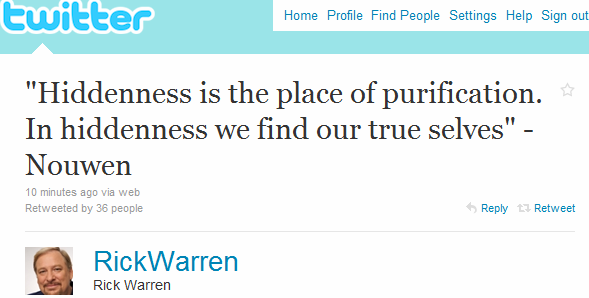
To give you some further perspective, Warren’s Twitter account tells us he has 153, 661 followers and he tweeted the below not long ago:


(Online source)

The “Nouwen” in the above tweet is the deceased Roman Catholic mystic Henri Nouwen. I told you recently in Christian Broadcasting Network Peddling Contemplative Spirituality—even today—Nouwen remains a leading teacher of the anti-biblical, and spiritually corrupt, Contemplative Spirituality/Mysticism (CSM) perpetrated in the pretending to be Protestant evangelical by Living Spiritual Teacher and Quaker mystic Richard Foster with his trusty spiritual twin Dallas Willard, under the guise of so-called Spiritual Formation.

Here we have Warren sending sheep to an apostate (at best) wolf who gave his life in service to a gospel contrary to the one you received (c.f. Galatians 1:9) in the Roman Catholic Church, which has placed its anathema upon the very Gospel of Jesus Christ itself. Ah, but what’s a little thing like the Protestant Reformation to Rick Warren; he can defecate upon the blood of the martyrs because he’s bigger than the Reformation. And what’s the Scriptures to Warren; only his personal playground where he romps with his Play-Doh Bible to twist in any shape he wishes.

We also have another case o the irrational philosophy gleaned from pagan religions: Hiddenness is the place of purification. Huh; what does that even mean, hiddenness. Yet guru Nouwen, and apparently PDL pope Warren, think ala Zen Buddhism we purifiy ourselves in the practice of “Christian” transcendental meditation in an altered state of consciousness, the so-called “silence and solitude” of Contemplative/Centering Prayer (CCP).

One of the Golden Buddhas of contemplative spirituality, Roman Catholic mystic monk Thomas Merton (1915-1968), had a lifelong devotion to CSM and its crown jewel of CCP would make him more like the Buddha than the Christ, which you can see in Thomas Merton And The Buddhas. Merton talks about this myth of supposed “true self” when he speculated that at “the center of our being is a point of nothingness which is untouched by sin and by illusion, a point of pure truth.”[1]

A couple of quick points: 1) This is actually a denial of the doctrine of original sin; and 2) if we are “untouched by sin” in “the center of our being,” then we don’t need a crucified and risen Savior. And following are a couple of the “revelations” Nouwen received after his own devotion to spurious CSM:

One of the discoveries we make in [contemplative/centering] prayer is that the closer we come to God, the closer we come to all our brothers and sisters in the human family. God is not a private God. The God who dwells in our inner sanctuary is also the God who dwells in the inner sanctuary of each human being.[2]
Today I personally believe that Jesus came to open the door to God’s house, all human beings can walk through that door, whether they know about Jesus or not. Today I see it as my call to help every person claim his or her way to God.[3]

I ask again: Why would you want to follow the toxic teaching, and practice the spirituality, of Henri Nouwen when it turned him into a universalist?
________________________________________________________________________________
End notes:
[1] Thomas Merton, Conjectures of a Guilty Bystander [New York: Doubleday, 1966], 158, emphasis mine.
[2]  Henri Nouwen, Here And Now [New York: Crossroad Publishing, 1994], 24, 25, emphasis mine.
[3] Henri Nouwen, Sabbatical Journey [New York: Crossroad Publishing, 1998], 51, emphasis mine.

(HT: Apprising Ministries)

Tuesday, June 29, 2010

The Shack Author: "The God of Evangelical Christianity is a Monster"


From Lighthouse Trails Research

On Friday night, author and researcher Ray Yungen attended a lecture at Concordia University in Portland, Oregon to hear The Shack author William Paul Young. The name of Young’s talk was “Can God Really Be That Good?” During the talk, Young told the audience that “the God of evangelical Christianity is a monster.” He was referring to the belief that God is a God of judgment and will judge the unbelieving. Young also rejects the biblical view of atonement (wherein Jesus died as a substitute for us to pay the price of our sins). This view by Young is evident in a radio interview he had one year ago where he rejected the biblical view of the atonement. He echoes the sentiments of William Shannon and Brennan Manning, who both say that the God who punishes His own son to pay for the sins of others does not exist:

He is the God who exacts the last drop of blood from His Son, so that His just anger, evoked by sin, may be appeased. This God whose moods alternate between graciousness and fierce anger — a God who is still all too familiar to many Christians — is a caricature of the true God. This God does not exist. (Shannon, Silence on Fire, p. 110, also see Manning who stated the very same thing in Above All, pp. 58-59 )

Young told the audience that his book has now sold 14 million copies. He says that he believes his book has been a “god thing” to heal people’s souls because so many people have been tainted by this evangelical God.

Young said his book is so effective because when you put something in a story form it gets past mental defenses.

Young’s obvious distain for evangelical Christianity (in a derogatory manner, he said there are “1.4 million” rules in the evangelical church) is shown in his book as well when The Shack’s “Jesus” states: “I have no desire to make them [people from all religious and political backgrounds] Christian, but I do want to join them in their transformation into sons and daughters of my Papa” (p. 184).

Young asked “evangelicals,” “Do you want to hold onto your darkness?” and answered for them, “No, you want to get rid of it.”

Saturday, May 22, 2010

Are There Many Roads to God? Part 7


Are there many roads to God? What is the bottome line?

From a biblical, Christian perspective, there is no way to escape the conclusion that Jesus is the only way to God, either through direct faith in Him, or by having the blood of Jesus applied to a person who has responded to God in faith through the testimony of instinct and nature.

To argue that there are other roads to God, as some apostate Christian leaders are doing today, is to deny that the sacrifice of Jesus was necessary for the forgiveness of sins. If there really are other roads to God, then Jesus came to earth to die a horrible death for no purpose. His sacrifice was all in vain. Either we are saved by the blood of Jesus, or we are not.

Road Signs

A Glorious Promise Concerning the Future

One thing we know for sure is that every person on earth who is alive at the end of the Tribulation will hear the Gospel before the Second Coming of Jesus. We know this because Jesus said it would happen (Matthew 24:14). That prophecy is being partially fulfilled today through the use of modern technology. Computers are being utilized to produce rapid translations of the Bible. Satellites are being used to transmit Gospel sermons worldwide.

But the ultimate fulfillment of the prophecy will occur near the end of the Great Tribulation when God will send forth an angel who will circumnavigate the globe and proclaim the Gospel to every person left alive at that time (Revelation 14:6-7). What glorious grace!

Are There Many Roads to God? Part 6 (Cultural Christians)

 Are There Many Roads to God? Part 5

Are There Many Roads to God? Part 4

Are There Many Roads to God? Part 2

Are There Many Roads to God? Part 1


Are There Many Roads to God? Part 6 (Cultural Christians)


What about professing Christians who have never been born again? Will they be going to Heaven?

What I have in mind are what I prefer to call "Cultural Christians." These are people who claim to be Christians because they profess to believe in Jesus, but they have no personal relationship with Him. Many of these are people who attend church regularly. Some are elders, deacons, teachers, and even pastors. Can they get to Heaven through church membership or by participating in Christian rites like baptism or communion?

The answer of the Bible is a clear "No!" Jesus Himself said that no man can see the kingdom of God unless he be "born again" (John 3:3). That means a person must put his faith in Jesus as his personal Lord and Savior. It is not sufficient to simply believe that Jesus lived. The Bible says that even "the demons believe and shudder" (James 2:19). But they have rejected Jesus as their Lord.

Going to church or participating in Christian rituals is not another road to Heaven. Our churches are filled with unsaved people who are trusting in their works to get them to Heaven. But the Bible says, "For by grace you have been saved through faith... not as a result of works, that no one should boast" (Ephesians 2:8-9).

In an interview I conducted recently with Dr. Robert Jeffress, pastor of First Baptist Church in Dallas, he pointed out that two words sum up one of the fundamental differences between Christianity and all other religions in the world. Those words are "do" and "done." Regarding access to Heaven, all the false religions of the world say, "DO!" Christianity, in stark contrast, proclaims "DONE!"1 In other words, Christianity declares that Jesus did everything necessary for our salvation through His death on the cross. There is nothing we can add to that.

False expressions of Christianity require you to earn your salvation by doing works that they require. True Christianity says there is nothing you can do to earn your salvation because it is a free gift of God through faith in Jesus as your Lord and Savior. In this sense, true Christianity is really not a religion; rather, it is a relationship. Jesus made this clear at the last supper with His disciples when He prayed to God, saying, "...this is eternal life, that they may know You, the only true God, and Jesus Christ whom You have sent" (John 17:3).

In this regard I feel compelled to state, respectfully, that this is an area where Billy Graham seems to have strayed from the Gospel. I say this because he has made it very clear in his writings and his public statements that he believes the Catholic Church is a true expression of Christianity.2

This is unfortunate because his endorsement of Catholicism has made many Catholics feel comfortable and safe in their faith. And although I am sure there are some Catholics who have truly placed their faith in Jesus, the vast majority have not because the Catholic Church has always taught salvation by works — which makes the religion of Catholicism a false form of Christianity.3

In the final Part 7 of this series "Are there many roads to God?", we'll get to the bottom line in answering this much asked question.

Parts 1-5:

Are There Many Roads to God? Part 5

Are There Many Roads to God? Part 4

Are There Many Roads to God? Part 2

Are There Many Roads to God? Part 1


Thursday, May 20, 2010

Are There Many Roads to God? Part 5


What about those today who live and die without ever hearing the Gospel? Are they destined to Hell?

I personally believe the same principle applies to them that applied to people living in Old Testament times before the First Advent of Jesus. Their fate will depend upon whether or not they ever responded to God in faith.

The Bible says that all people have an instinctive knowledge that God exists (Romans 2:14-15). Further, the Bible says that we can realize the existence of God by observing the complexity and beauty of the creation (Psalm 19:1-6).

Because God is a just God (Psalm 89:14), I believe He will hold us responsible for what we knew. Those exposed to the Gospel and reject it will be lost. Those who have only the testimony of instinct and the creation who reject that testimony will also be lost. But those who hear the Gospel and put their faith in Jesus will be saved. And those who respond to the testimony of instinct and the creation by putting their faith in their Creator will also be saved. However, this latter group will be saved only by having the blood of Jesus applied to them as was the case with Old Testament saints.

A Controversial Statement

I believe this is what Billy Graham had in mind in May of 1997 when he made a very controversial statement during an interview of him that was being conducted by Robert Schuller.1 He said that he believed that God is "calling people out of the world for His name" — including the Muslim world, the Buddhist world, the Christian world and the non-believing world. He added, "They may not even know the name of Jesus, but they know in their hearts that they need something that they don't have, and they turn to the only light they have, and I think that they are saved, and that they're going to be with us in Heaven."

Schuller responded by asking, "What I hear you saying is that it is possible for Jesus Christ to come into human hearts and soul and life, even if they've been born in darkness and have never had exposure to the Bible. Is that a correct interpretation of what you're saying?"

Graham's reply was, "Yes, it is...I've met people in various parts of the world in tribal situations, that they have never seen a Bible or heard about a Bible, and never heard of Jesus, but they've believed in their hearts that there was a God, and they've tried to live a life that was quite apart from the surrounding community in which they lived."

These comments by Graham produced a flood of condemnation of him. People accused him of believing in many different roads to God. It is certainly easy to see how his comments could have been misconstrued, but I believe that is exactly what happened.

Dr. Billy Graham

Billy Graham has never taught that there are many roads to God. On his website (http://www.billygraham.org/) there are two very specific articles about salvation in which Graham affirms his often stated belief that Jesus is the only way to God.2 In his controversial statement, which was much too briefly phrased, I think he was only saying that people are going to be judged on the basis of what they knew about God and how they responded to that knowledge, just as was the case in Old Testament times.3

Some might respond by saying, "If those who live and die without ever hearing of Jesus might still be saved by their faith in God, whereas those who hear the Gospel and reject it will be lost, then perhaps we should stop proclaiming the Gospel!"

But this statement is based on the faulty assumption that the Gospel is just a fire insurance policy. The truth is that it is much more than that, for the person who receives Jesus as Lord and Savior is blessed with the indwelling power of the Holy Spirit, receiving supernatural power to live triumphantly in a world of heartache and suffering. The person is also enabled to know God personally in this life — an absolutely invaluable blessing.

Further, I believe that any person who would respond to God in faith based on instinct and the witness of the creation is one who would accept the Gospel if exposed to it.

In Part 6 of this series answering the question, "Are there many roads to God?", we'll address the conundrum of the Cultural Christian.

Are There Many Roads to God? Part 4

Are There Many Roads to God? Part 2

Are There Many Roads to God? Part 1


Wednesday, May 19, 2010

Are There Many Roads to God? Part 4


This brings us to a crucial question: Are there any exceptions to the rule that you must place your faith in Jesus in order to be saved?
 
The answer is yes. Most Christian theologians would agree that there are three groups of people who have been saved without placing their faith in Jesus.

Exception #1: Children

The first group is composed of those children who have died before the age of accountability. The Bible does not specifically state this truth. It is arrived at through deduction from biblical statements.

First, there is the example of King David's child that was born of Bathsheba. When the child died seven days after it was born, David proclaimed by inspiration of the Holy Spirit that although the child could not come back to him, one day he would go to be with the child (2 Samuel 12:23). The idea that those who die before the age of accountability will be saved is reinforced in the New Testament in the words of Jesus in Matthew 19:13-14 —
Then some children were brought to Him so that He might lay His hands on them and pray; and the disciples rebuked them. But Jesus said, 'Let the children alone, and do not hinder them from coming to Me; for the kingdom of heaven belongs to such as these.'"

This principle of not holding children accountable for their sins before they know the difference between right and wrong is also reflected in a story in the book of Deuteronomy. When the Israelites balked at entering the Promised Land because they were afraid they would be defeated by the Canaanites, God punished them for not trusting Him by making them wander in the wilderness until the rebellious generation had died off (see Numbers 13 & 14).

The Lord proclaimed that only two people of the current generation would be allowed to enter the land — namely, Caleb and Joshua, the two spies out of twelve who brought back a positive report stating they believed the Lord would defeat their enemies (Deuteronomy 1:34-38). But then, another exception was made: "Moreover, your little ones...who this day have no knowledge of good or evil, shall enter there [the Promised Land], and I will give it to them, and they shall possess it" (Deuteronomy 1:39).

Jesus With Children

Another argument in behalf of the salvation of children who die before the age of accountability is the justice of God. The Bible asserts over and over that our Creator is a God of justice (Zephaniah 3:5). He has an overwhelming passion for justice (Micah 6:8). And He promises repeatedly that justice will be one of the characteristics of His Son's millennial reign (Isaiah 42:1-4). How could a God of perfect justice condemn to Hell children who never knew the difference in right and wrong?

Those who die before the age of accountability will not be eligible to receive special rewards for faithfully serving the Lord, but it appears that they will be granted eternal life. However, this can happen only by having the blood of Jesus applied to them (Hebrews 9:22).

Exception #2: Mentally Handicapped

This same exception would apply to the mentally handicapped who reach adulthood. Since they are incapable of determining right from wrong and are also incapable of repenting and putting their faith in Jesus, it is only reasonable to conclude that a just God would not hold them accountable and would apply the blood of Jesus to their sins.

I have a step-grandson named Jason who falls into this category. At about the age of three a genetic defect was activated that caused his immune system to attack his brain. The effect was a frontal lobotomy that rendered him vegetative. I have since dedicated two books to him. He is a constant reminder to me of the fact that we live in a fallen world. I have no doubt that one day, either at death or at the Rapture, his mind will be set right, and I will be able to enjoy his fellowship eternally.

Exception #3: Old Testament Saints

The third group that has been saved apart from faith in Jesus are those people who lived and died before the birth and revelation of Jesus as God's Son, but who placed their faith in their Creator. Hebrews 11 tells us that people like Abel, Enoch, Noah, and Abraham were justified by their faith in God. They had no Scriptures nor any knowledge of Jesus, yet because they related to their Creator in faith, they were saved. Specifically, Genesis 15:6 says that because Abraham believed the Lord, "it was reckoned to him as righteousness."

Still, each of these people, and many others like them, were dependent upon the sacrifice of Jesus for their salvation to be sealed. Their faith covered their sins, but the forgiveness of their sins depended upon the sacrifice of a perfect person who did not deserve to die. Only the blood of such a person could produce forgiveness of their sins.

That's why Old Testament saints did not go directly to Heaven when they died. They went, instead, to a place called Sheol (Hades in the New Testament), and their souls resided in a compartment called "Abraham's bosom" or "Paradise." They could not be ushered into the presence of a Holy God until their sins were forgiven.

After Jesus' death on the Cross, He descended into Hades and made a proclamation (1 Peter 3:19). We are not told specifically what He said, but most likely it was, "The blood has been shed!" I'm sure those words must have produced a chorus of "Hallelujahs!" We are also told that when Jesus ascended into Heaven, He took a "host of captives" with Him (Ephesians 4:8). In other words, He emptied Hades of those who were saved. Paradise was moved from Hades to Heaven, a reality that Paul later affirmed when he said that he was taken up to "the third heaven," which he identified as Paradise (2 Corinthians 12:1-4).

In Part 5 of this series answering the question, "Are there many roads to God?", we'll tackle the difficult predicament of those who live and die without ever having heard the Gospel.

Read Part 1-3 here:

Are There Many Roads to God? Part 3

Are There Many Roads to God? Part 2

Are There Many Roads to God? Part 1


Monday, May 17, 2010

Are There Many Roads to God? Part 3


Didn't Paul say in 1 Timothy 2:3 that God "desires all men to be saved"? Yes, he did say that, and Peter repeated it in 2 Peter 3:9 where he asserted that "God does not wish that any should perish, but that all should come to repentance."

There is no doubt that it is God's perfect will that all should be saved. But in His permissive will, God allows people to reject His Son and thus be lost. In other words, God does not force anyone to be saved. And because of the depraved nature of Mankind, the vast majority of those who have ever lived will be lost and consigned to Hell as their eternal destiny.

Jesus Himself emphasized this truth in His sermon delivered on the Hill of the Beatitudes in Galilee. Jesus stated point blank: "...The gate is wide, and the way is broad that leads to destruction, and many are those who enter by it. For the gate is small, and the way is narrow that leads to life, and few are those who find it...Not everyone who says to Me, 'Lord, Lord,' will enter the kingdom of heaven; but he who does the will of My Father who is in heaven" (Matthew 7:13-14 & 21).

The Nature of Man

Again, the Bible emphasizes that the fundamental nature of Man is evil because we are born with a sin nature that puts us in rebellion against the holiness of God. As the prophet Jeremiah put it: "There is nothing more deceitful than the human heart" (Jeremiah 17:9). Likewise, King David wrote: "There is no one who does good...they have all turned aside...there is no one who does good, not even one" (Psalm 14:1-3). The Apostle Paul affirmed this truth in his letter to the Romans when he quoted David's statement in detail (Romans 3:10-18).

The biblical message is adamant that because of our natural depravity, we have no hope apart from faith in a Savior, and Jesus is that Savior. Isaiah summed it up this way in a prophecy about the promised Messiah: "All of us like sheep have gone astray. Each of us has turned to his own way; but the Lord has caused the iniquity of us all to fall on Him [the Messiah]" (Isaiah 53:6).

The message of the Scriptures is clear. There is only one road to God and that is through Jesus of Nazareth. There is no hope in the modern day false religions of Rabbinical Judaism, Islam, Buddhism, Hinduism, or any of the multitude of natural religions like Animism. Here's how the great Southern Gospel quartet, The Imperials, expressed this concept in their unique song, "Old Buddha," composed by Mark Farrow —

Buddha
Well, old Buddha was a man
And I'm sure that he did well,
But I pray for his disciples
Lest they end up in hell,
And I'm sure that old Mohammed
Was sure he knew the way,
But it won't be Hari Krishna
We stand before on judgment day.

Chorus:
No, it won't be old Buddha
That's sitting on the throne,
And it won't be old Mohammed
That's calling me home,
And it won't be Hari Krishna
That plays that trumpet tune,
And we're going to see the Son,
Not Reverend Moon!

Well, I don't hate anybody,
So please don't take me wrong,
But there really is a message
In this simple song,
See, there's only one way — Jesus,
If eternal life's your goal,
And meditation of the mind,
It won't save your soul.
In Part 4 of this series answering the question, "Are there many roads to God?", we'll look to see if there are any exceptions to the rule that you must place your faith in Jesus alone in order to be saved.

You can read Part 1 and 2 here:

Are There Many Roads to God? Part 2

Are There Many Roads to God? Part 1


Friday, May 14, 2010

Are There Many Roads to God? Part 2


The teachings of Jesus that He is the only way to salvation and therefore God are affirmed in the writings of the Apostles, as you can see from the following statements —

In the first Gospel sermon ever preached, Peter made a bold assertion: "Therefore, let all the house of Israel know for certain that God has made Him [Jesus] both Lord and Christ [Messiah] — this Jesus whom you crucified." Peter then commanded his audience to "repent and let each of you be baptized in the name of Jesus Christ for the forgiveness of your sins" (Acts 2:36-38).

Not long after this, Peter was arrested and hauled before the Sanhedrin Council — the very group of Jewish leaders who had condemned Jesus to death. In his statement to them, he said: "Let it be known to all of you, and to all the people of Israel that by the name of Jesus Christ the Nazarene, whom you crucified, whom God raised from the dead...there is salvation in no one else, for there is no other name under heaven that has been given among men by which we must be saved" (Acts 4:10-12).

The Apostle Paul affirmed Peter's point in a letter he wrote to Timothy: "God our Savior desires all men to be saved and to come to the knowledge of the truth. For there is one God, and one mediator also between God and men, the man Christ Jesus who gave Himself as a ransom for all..." (1 Timothy 2:3-6).

In like manner, the Apostle John confirmed that Jesus is the only hope of salvation when he wrote: "Who is the liar but the one who denies that Jesus is the Christ [Messiah]? This is the antichrist, the one who denies the Father and the Son. Whoever denies the Son does not have the Father; the one who confesses the Son has the Father also" (1 John 2:22-23). John repeated this principle when he added: "...God has given us eternal life, and this life is in His Son. He who has the Son has the life; he who does not have the Son of God does not have the life" (1 John 5:11-12).

Again, the conclusions that can be drawn from these statements are self-evident:
  1. Jesus was the Messiah — the Savior — promised by God.
  2. There is salvation in no other person except Jesus.
  3. Those who reject Jesus are guilty of rejecting the Father.
Confirmation of these conclusions can be found in a sermon delivered by John the Baptist in which he proclaimed: "He who believes in the Son has eternal life; but he who does not obey the Son shall not see life, but the wrath of God abides on him" (John 3:36). John's statement makes it clear that God must deal with sin for He is a just God (Psalm 37:28 and Isaiah 61:8). He deals with sin in one of two ways, either grace or wrath. Whether or not a person is under grace or wrath depends upon whether he or she has put their faith in Jesus as their Lord and Savior. Those who have done so, have the promise of eternal life. Those who refuse to do so will experience God's wrath.

In Part 3 of this series answering the question, "Are there many roads to God?", we'll look at God's desire pertaining to salvation in relation to the nature of man.


Read Part 1 HERE

COEXIST?


By Justin Edwards

You've all seen them on car bumpers and rear glass, maybe you even have one on your own car. If that's the case, please continue reading. Perhaps you've never considered this before, but the idea behind these COEXIST bumper stickers is among the greatest lies ever told. Let me explain.

I was actually behind this bumper sticker earlier this week. In addition to COEXIST, they also had an interesting PEACE bumper sticker with the same play on religions, as well as this one, “FREEDOM OF RELIGION MEANS ALL RELIGIONS”.

Granted, that simple statement is true as far as our U.S. Constitution is concerned (and rightly so), but the context behind it, or at least in context with this driver’s other bumper stickers, only led me to think they believe all religions are valid. After all, who is anyone to say only one is correct (especially Christianity)? It made me sad to think how widespread this deception is. So after reading Mike Ratliff's article Wednesday, Are You Ashamed of That Stumbling Block?, I decided to go ahead and write this article. And if you get a chance, please read Mike's timely article as well.

In the name of Universalism, many a soul will be damned.  Universalism is the belief that all roads eventually lead to heaven, including atheism. All mankind will be saved no matter the path they follow. This cannot be further from the truth. Jesus said in John 14:6, "I am the way, the truth, and the life. No one comes to the Father except through Me." I've met professed Christians who know of this eternal truth who continue to claim "to each his own" or "my way is not necessarily right for everyone" or "it's not my place to tell someone they are wrong in what they believe". My friend, you are in grave error!

An essential doctrine of Christianity is that absolutely no one can enter heaven except they go through the blood of Jesus Christ. God is holy and there will be no unrighteousness in heaven, therefore, the only way one can become righteous in His sight is by receiving the righteousness of Christ by the grace of God through faith alone (Ephesians 2:8-9). This faith comes through trusting in Christ as Lord and Savior and repentance from yourself in turning to God in surrender. You cannot save yourself nor can you work for your salvation, which is the deception of all other religions.

Christianity is the only religion (to use the term loosely) that does not require works to go to heaven. Hinduism, Islam, Buddhism, Mormonism and Roman Catholicism all require the practitioner to perform works to some degree. In Christ, there is freedom - true freedom that can only come through the washing of sins and justification by faith alone in Christ and His finished work on the cross. These religions create a system of bondage where one can only hope their good works outweigh their evil deeds in the end. The cult of liberalism is largely responsible for this idea entering the church, and more recently through Emergence Christianity of this post-modern society. This intermixing of ideologies, religions, and the New Age is the foundation of what will become the universal religion during the Tribulation period. The co-mingling of religions is largely responsible for the falling away that we see in 2 Thessalonians 2:3, which must take place before Christ returns. It is one of the greatest tangible evidences the Wrath of God is ready to be poured out on earth and its dwellers.

If you are one who believes all religions should coexist peacefully, I agree with you. Christians especially must express their love for all people in word and deed. We are to be the salt and light of this world, else how will the lost see the love of Jesus Christ but through His own children? Unfortunately, however, coexisting in the name of tolerance and moral relativism is impossible as there is only one God and one path through His Son Jesus Christ. Ultimately, darkness and light contradict one another as Ephesians 6:12 says,

12 For we do not wrestle against flesh and blood, but against principalities, against powers, against the rulers of the darkness of this age, against spiritual hosts of wickedness in the heavenly places.

To put it bluntly, all other religions are derived from the pit of hell. They are a means for Satan to deceive the masses away from the truth and grace offered by a holy and sovereign God. To deny that Jesus is the only way for salvation is to diminish His blood sacrifice. To deny there is an eternal hell is to belittle the torment and excruciating death of the Savior. To deny these truths is to call God a liar.

If you are a professed Christian who believes there is more than one path, I plead with you to study the Bible for yourself and repent from this heresy. If you do not believe in Christ, I plead with you to search the Scriptures and pray the Holy Spirit reveals Himself to you. The average human life span is around 75 years, where will you be 1 TRILLION years from now? For 1 trillion years, will you have been worshiping and serving the Lord in heaven or will you have been suffering in the darkness of eternal hellfire? What about 100 TRILLION years after that?  Isn't an eternity worth spending a few hours or days searching out these truths now?

Don't put your trust in man-made traditions or in the god you have made up in your own mind. If you say you believe in God, then do yourself a favor and make sure you believe in the God of the Bible. The consequences will be the difference between an eternity with Jesus or an eternity of damnation. Matthew 7:13-14

Enter by the narrow gate; for wide is the gate and broad is the way that leads to destruction, and there are many who go in by it. 14 Because narrow is the gate and difficult is the way which leads to life, and there are few who find it.


Thursday, May 13, 2010

Are There Many Roads to God? Part 1


"What will happen to those who have never heard the Gospel?"

This is one of the most frequent questions I receive. People believe that God is just, and they cannot reconcile that belief with the idea that He might consign a person to Hell who never was given an opportunity to hear the Gospel.

Therefore, increasingly, many Christians are concluding that there must be many roads to God and that sincere Jews and Muslims and Buddhists and others will make it to Heaven.

Crucial Questions

What does the Bible have to say about this important issue? Are those who live and die without hearing the Gospel condemned to an eternity in Hell? And what about those who have put their faith in the god of some religion other than Christianity and who strive to live righteous lives? Are they also condemned to Hell? Is it possible that God has revealed Himself in different ways to different peoples, and therefore there are many different roads to God? Could the sign be true that I saw in a Sunday School class at a church that read: "Our God is too big to be confined to one religion"?

What Jesus Had to Say

Let's begin our search for an answer to these questions by taking a look at what Jesus had to say —
Speaking to the Apostle Thomas, Jesus said, "I am the way, and the truth, and the life; no one comes to the Father, but through Me." — John 14:6

After appointing His twelve Apostles, Jesus said to them: "Everyone therefore who shall confess Me before men, I will also confess him before My Father who is in heaven. But whoever shall deny Me before men, I will also deny him before My Father who is in heaven." — Matthew 10:32-33

Speaking to 70 disciples being sent forth to proclaim the kingdom of God, Jesus said: "The one who listens to you listens to Me, and the one who rejects you rejects Me; and he who rejects Me rejects the One who sent Me." — Luke 10:16

Early in His ministry, while in Jerusalem, Jesus delivered a sermon on His relationship with God the Father, and in it He said: "Truly, truly, I say to you, he who hears My word, and believes Him who sent Me, has eternal life, and does not come into judgment, but has passed out of death into life." — John 5:24
At His last supper with the Apostles, Jesus prayed: "And this is eternal life, that they may know You, the only true God, and Jesus Christ whom You have sent." — John 17:3

And then, of course, there is Jesus' most famous statement about the issue of salvation — the words He spoke to Nicodemus, a Jewish spiritual leader who was a member of the Sanhedrin Council: "For God so loved the world that He gave His only begotten Son, that whoever believes in Him should not perish, but have eternal life." — John 3:16

What conclusion can we draw from these statements? I would propose the following:
  1. Jesus is the one and only way to God.
  2. Those who put their faith in Jesus as Lord and Savior will be saved.
  3. Those who reject Jesus will be condemned, for those who reject Jesus are guilty of rejecting God.
  4. The essence of salvation is a personal relationship with Jesus.


In Part 2 of this series answering the question, "Are there many roads to God?", we'll look at how the Apostles answered the question.

Thursday, March 18, 2010

Heretical Bumper Stickers (VLOG)


By Justin Edwards

Crucial is on fire in this video. There is only One True God, and He fits in NO RELIGION....Amen, brother!!

Do you ever notice bumper stickers with some pretty shady and deceiving messages? Well I saw one the other day that was nothing but a complete HERESY.


Friday, March 12, 2010

Ray Yungen on Contemplative Prayer


By Justin Edwards

The following 2-part video by Ray Yungen gives an excellent outline of the mystical practice of contemplative prayer (centering prayer) and how it serves to bridge all religions together. I have also provided notes from the videos below, but I encourage you to watch the videos for proper context.


  • Society is being reconstructed along mystical lines
  • The "normal" Christian doesn't pray with the five senses - you're not gonna get God's full attention unless you get into "the silence"
  • The Desert Fathers - experimented with different disciplines, some of which were too harsh or extreme (is anything from God too harsh or extreme???)
    • Contemplative Prayer is outside of Biblical context
  • Thomas Merton - icon of contemplative prayer
    • Christians cannot fulfill mission without contemplative prayer (not the Great Commission mind you)
    • Center of being is a point of nothingness untouched by sin or illusions - it is the pure glory of God! (this is the higher self in New Age)
    • considered a Sufi Sheik mystic a great saint and filled with the Holy Spirit - believed he spoke the same mystical language as this Sufi
    • believed he was deeply impregnated with Sufism
  • Henri Nowen - contemplative prayer opens us to God's active presence - prayer, wisdom, and silence
    • All humans can walk through door whether they know Jesus or not
    • "my call is to help every person claim his or her own way to God"
  • Richard Foster - All should enroll in the school of contemplative prayer
  • Brennan Manning - first step of faith is to stop thinking about God at the moment of prayer
  • Everyone that goes into these trances finds out they are one with everything - panentheism
  • Sue Monk Kidd - southern baptist Sunday school teacher in SC turned mystic
    • student of Thomas Merton
    • "God become steam of my soup, graffiti on the building, rust on the fence" - New Age
    • Transition into goddess conscious
      • needs goddess conscious to reveal earth's holiness
      • matter becomes inspirited
      • goddessness offers us the holiness of everything
      • "my ultimate authority is the divine voice in my own soul. period"
  • Reimagining Christianity - Alan Jones
    • "The life of contemplative prayer,...Loved and in communion with all things, the soul is born in and out of the secret silence of God. This silence at the heart of mysticism is not only the meeting point of the great traditions [religions] but also where all hearts might meet."
    • all humanity can be united
    • Brian McLaren on back cover - "Alan Jones is a pioneer in reimagining the Christian faith that emerges from authentic spirituality" (contemplative prayer)
    • McLaren is "encouraged deeply" that all religions can unite under this mystical practice
  • Tony Jones - "The basic method  promoted in The Cloud [of Unknowing] is to move beyond thinking into a place of utter stillness with the Lord...the believer must first achieve a state of silence and contemplation, and then God works in the believer's heart."

  • Rick Warren - "The Bible tells us to pray all the time. One way is to use breath prayers throughout the day...you choose a brief sentence or a small phrase that can be repeated to Jesus in one breath...pray it as often as possible." (this is mantra meditation)
    • Warren esteems Catholic monk Brother Lawrence - Practicing the Presence of God
  • Gary Thomas - Sacred Ways
    • "In general, centering prayer works like this: choose a word (Jesus or Father, for example) as a focus for contemplative prayer. Repeat word silently in your mind for a set amount of time (say 20 minutes) until your heart seems to be repeating the word by itself just as naturally and involuntary as breathing." (this is no different than other meditative practices found in Eastern traditions)
    • Rick Warren on Gary Thomas - "Gary has spoken at Saddleback and I think highly of his work...he tells them [the readers] how they can make the most of their spiritual journeys on practicing spiritual exercises."
  •  Karl Rahner - "The Christian of the future will be a mystic or he or she will be nothing at all."  
  • Contemplative prayer is an esoteric tradition - convents, monasteries
  • True prayer is a personal relationship with God
  • You will not find contemplative prayer in any of the Apostle Paul's epistles 
  • Jesus - "And when you pray, do not use vain repetitions as the heathen do. For they think that they will be heard for their many words."- Matthew 6:7
  • I Timothy 4:1 - "Now the Spirit expressly says that in latter times some will depart from the faith, giving heed to deceiving spirits and doctrines of demons,"

Friday, March 5, 2010

Uniting All Religions through Meditation


By Justin Edwards

This week we've discussed the New Age, contemplative spirituality and mysticism (CSM), and the vessels that each uses to become "one with god" - meditation. It was mentioned that CSM is the bridge to all religions as each has a mystical element that unites them as one - each seeks to tap into the "god within" or the "light within". This stands in blatant contradiction to the Word of God as Christ only dwells in those who are born again children of God. Jesus said in John 14:6,

I am the way and the truth and the life. No one comes to the Father except through me.

And in John 3:3,

In reply Jesus declared, "I tell you the truth, no one can see the kingdom of God unless he is born again.  

And Paul said in Romans 10:9-10,

That if you confess with your mouth, "Jesus is Lord," and believe in your heart that God raised him from the dead, you will be saved. For it is with your heart that you believe and are justified, and it is with your mouth that you confess and are saved.

You will not find this clear teaching from Scripture in the Emergent Church - that you must be born again, that Jesus is the only way to the Father in heaven, and that you must believe in His resurrection and confess His Lordship to receive eternal life. The fact is, within the frame of postmodern philosophy, the EC cannot take an absolute standing for truth.

The following information epitomizes where the EC is heading - if they are not already there. The material comes from the website of the World Community for Christian Meditation. This should serve as a primary example of the commonality meditation offers individuals of all religions and cultures - to be enlightened and become one with god - for god is all, and is in all. You will find no mention of faith in Jesus Christ through repentance. You will not find that Jesus is the only way. Rather, you will see that all religions are equal and all roads are the right road. For the sake of "peace and unity" they forfeit their soul.

This is what you can expect from a church headed down the Emergent road of destruction. The work on the cross is removed and all faiths are encouraged to unite for world peace and justice. The following should speak for itself:

The World Community for Christian Meditation

The Community is a kind of 'monastery without walls', a family of national communities and emerging communities in over a hundred countries....The World Community is ecumenical and serves a universal 'catholic' unity in its dialogue both with Christian churches and other faiths. We encourage and try to support the daily practice of meditation knowing its power to change hearts and so to transform our world....We contribute often to interfaith dialogue particularly, in recent years with Buddhists and Muslims.

Meditation, of course, is a Universal Tradition found in all the great religions. As such, it offers an important common ground for inter-religious dialog and a basis for peace in the world. Many Christians have been helped to recover contact with their own tradition of meditation, or contemplative prayer...Meditation helps people of all ages and cultures to find a simple, practical and meaningful way to awaken and deepen their spiritual life.

To understand the meaning of meditation we need to understand better what “contemplation” means. In ancient wisdom contemplation was seen as the goal of life, the good life. Contemplation is an essential and universal element of the human person and human life.

It is one that can be embraced and practiced by people today of all ages and walks of life. In this simple insight, [John Main] opened a way for the recovery of the contemplative dimension for Christians of all traditions, East and West, Catholic and Reformed. It also opens the windows on a wider and deeper meeting between the contemplative religions of Asia with Christianity. 

From that perspective we can begin to see how a global spiritual consciousness can be developed to help us work for peace, fight for justice, identify with the oppressed, love our environment and heal our social institutions and economy.

Find a quiet place. Sit down with your back upright. Sit still.

Gently close your eyes and begin to recite your prayer-word, or mantra, silently, interiorly and lovingly throughout the time of your meditation...Do not think about the meaning of the word. Just give your attention to the sound of it throughout the time of your meditation, from the beginning to the end. Whenever distractions arise, simply return to your mantra. Meditate for 30 minutes each morning and each evening, every day of your life...Meditation is a way of pure prayer marked by silence, stillness, and simplicity.

What makes meditation different as a spiritual practice is that it is not practiced as a technique...As a discipline, we bring a dimension of faith and perseverance to meditation. Perhaps we have to practice for some time before we really understand what that faith means.

What makes meditation Christian is your Christian faith. It isn't the technique that makes it Christian -- or Buddhist or Hindu. It is the faith that you bring to it. That is why it is such a marvelous way for each person, whatever their faith, to fulfill their faith journey and personally verify the truths of their faith while, at the same time, sharing deeply a spiritual experience with people of other faiths. The terrible error is saying, "Well, I believe in my faith, and that means that somebody else's faith must be wrong." Logically, intellectually, that is where we get stuck. But at the level of the spirit, we experience unity, and unity is what meditation leads us to. This becomes quite a perceptible reality as you meditate in a group. You don't communicate through language or through the body when you meditate. But there is a deeper communication at work.

And that "deeper communication" is becoming one with all.

Thursday, February 25, 2010

13 Heresies in The Shack


From: The Crosstalk Blog

The Shack continues as a best seller, and evangelicals and otherwise conservative churches are eating it up.There are 13 separate heresies about God in the novel. We know they are heresies because they contradict what the Bible plainly teaches about God. Without the Bible as our standard for truth, we are making God over in any image of our choice. Today on Crosstalk, our guest is Pastor Larry DeBruyn who has written a book on the seductive spirituality of The Shack. The book is, Unshackled: Breaking Away from Seductive Spirituality and it is available by calling 800-729-9829. It has caught on like wildfire because Christians today let their feelings determine truth rather than let truth dictate their feelings. Here are the false representations of God found in The Shack. They are written by Dr. Michael Youssef, a nationally televised pastor, who preaches an entire sermon on the book. Scroll down at this link to see the video box that says, “Michael Youssef’s Message.”

Thirteen Heresies in The Shack

1. God the Father was crucified with Jesus.

Because God’s eyes are pure and cannot look upon sin, the Bible says that God would not look upon His own beloved Son as He hung on the Cross, carrying our sins (Habakkuk 1:13; Matthew 27:45).

2. God is limited by His love and cannot practice justice.

The Bible declares that God’s love and His justice are two sides of the same coin — equally a part of the personality and the character of God (Isaiah 61:8; Hosea 2:19).

3. On the Cross, God forgave all of humanity, whether they repent or not. Some choose a relationship with Him, but He forgives them all regardless.

Jesus explained that only those who come to Him will be saved (John 14:6).

4. Hierarchical structures, whether they are in the Church or in the government, are evil.

Our God is a God of order (Job 25:2).

5. God will never judge people for their sins.

The Word of God repeatedly invites people to escape from the judgment of God by believing in Jesus Christ, His Son (Romans 2:16; 2 Timothy 4:1-3).

6. There is not a hierarchical structure in the Godhead, just a circle of unity.

The Bible says that Jesus submitted to the will of the Father. This doesn’t mean that one Person is higher or better than the other; just unique. Jesus said, “I came to do the will of Him who sent me. I am here to obey my Father.” Jesus also said, “I will send you the Holy Spirit” (John 4:34, 6:44, 14:26, 15:26).

7. God submits to human wishes and choices.

Far from God submitting to us, Jesus said, “Narrow is the way that leads to eternal life.” We are to submit to Him in all things, for His glory and because of what He has accomplished for us (Matthew 7:13-15).

8. Justice will never take place because of love.

The Bible teaches that when God’s love is rejected, and when the offer of salvation and forgiveness is rejected, justice must take place or God has sent Jesus Christ to die on the cross for nothing (Matthew 12:20; Romans 3:25-26).

9. There is no such a thing as eternal judgment or torment in hell.

Jesus’ own description of hell is vivid … it cannot be denied (Luke 12:5, 16:23).

10. Jesus is walking with all people in their different journeys to God, and it doesn’t matter which way you get to Him.

Jesus said, “I am the way, the truth, and the life, and no one will come to the Father but by me” (John 14:6).

11. Jesus is constantly being transformed along with us.

Jesus, who dwells in the splendor of heaven, sits at the right hand of God, reigning and ruling the universe. The Bible says, “In Him there is no change, for He is yesterday, today, and forever” (Hebrews 11:12, 13:8; James 1:17).

12. There is no need for faith or reconciliation with God because everyone will make it to heaven.

Jesus said, “Only those who believe in me will have eternal life” (John 3:15, 3:36, 5:24, 6:40).

13. The Bible is not true because it reduces God to paper.

The Bible is God-breathed. Sure, there were many men through 1,800 years who put pen to paper (so to speak), each from different professions and different backgrounds, but the Holy Spirit infused their work with God’s words. These men were writing the same message from Genesis to Revelation.

Listen here as William Paul Young denies the penal substitutionary atonemenf of Christ, cardinal doctrine, folks. (Fast forward to hear the specific denial 16 minutes in.)

**Note**Last July, Elmbrook Church, a large evangelical megachurch in Waukesha, Wisconsin, featured William Paul Young as a speaker and promoted it on secular media to draw in outsiders. They defended their hosting of Mr. Young with a shocking set of lies that are so obviously refuted it beggars belief. You can read Elmbrook’s claims here about Young’s book. Then get Pastor DeBruyn’s book, filled with footnotes and see for yourself. When pastors at Elmbrook include no proof or Scriptures to defend their positive claims about The Shack, and Pastor DeBruyn has filled his book with footnotes and detailed claims, it says volumes. These pastors have so dumbed down their congregations that a line or two of assurance is all that’s needed. They are trained to believe whatever they are told, not to go to the Scriptures themselves. Decades of not teaching the Word results in this kind of seduction. That members would accept their pastors’ word on this without any kind of Berean approach to Scripture is symptomatic of the times in which we live.

Wednesday, February 24, 2010

What is the Emerging Church?


By Justin Edwards

Because this blog is dedicated to defending the faith, it is essential to define the greatest threat to biblical Christianity today: the Emerging Church Movement. The leaders of this not-so-New Age-movement seek to destroy the essential doctrines of Christianity, which are core fundamentals of the faith even unto salvation. Such doctrines include the atoning sacrifice of Jesus Christ, the reality of a physical hell, original sin, and even that Jesus is the only way to eternal life.

The energy that binds these heretical teachings is contemplative spirituality and mysticism. Contemplative prayer (also known as centering prayer)  is nothing short of transcendental meditation (TM), and its religious system is mysticism, which provides a bridge for all religions leading to universalism.

The following article from Got Questions provides a general overview of the Emerging Church, and in the days and weeks to come I will provide key resources explaining this movement in more detail including the occult religious practices it offers. I will indeed be naming names.

If you are part of an emerging church or are seeking more information about the dangers of this movement, I encourage you to stay tuned.

Question: "What is the emerging / emergent church movement?"

Answer:
The emerging, or emergent, church movement takes its name from the idea that as culture changes, a new church should emerge in response. In this case, it is a response by various church leaders to the current era of post-modernism. Although post-modernism began in the 1950s, the church didn't really seek to conform to its tenets until the 1990s. Post-modernism can be thought of as a dissolution of "cold, hard fact" in favor of "warm, fuzzy subjectivity." The emerging / emergent church movement can be thought of the same way.

The emerging / emergent church movement falls into line with basic post-modernist thinking—it is about experience over reason, subjectivity over objectivity, spirituality over religion, images over words, outward over inward, feelings over truth. These are reactions to modernism and are thought to be necessary in order to actively engage contemporary culture. This movement is still fairly new, though, so there is not yet a standard method of "doing" church amongst the groups choosing to take a post-modern mindset. In fact, the emerging church rejects any standard methodology for doing anything. Therefore, there is a huge range of how far groups take a post-modernist approach to Christianity. Some groups go only a little way in order to impact their community for Christ, and remain biblically sound. Most groups, however, embrace post-modernist thinking, which eventually leads to a very liberal, loose translation of the Bible. This, in turn, lends to liberal doctrine and theology.

For example, because experience is valued more highly than reason, truth becomes relative. Relativism opens up all kinds of problems, as it destroys the standard that the Bible contains absolute truth, negating the belief that biblical truth can be absolute. If the Bible is not our source for absolute truth, and personal experience is allowed to define and interpret what truth actually is, a saving faith in Jesus Christ is rendered meaningless.

Another area where the emerging / emergent church movement has become anti-biblical is its focus on ecumenism. Unity among people coming from different religious and ethnic backgrounds and diversity in the expression of corporate worship are a strong focus of the emergent church movement. Being ecumenical means that compromise is taking place, and this results in a watering down of Scripture in favor of not offending an apostate. This is in direct opposition to passages such as Revelation 2:14-17, Jesus' letter to the church of Pergamum, in which the Church is warned against tolerating those who teach false doctrine.

False doctrine seems to abound within the emerging / emergent church movement, though, as stated previously, not within every group espousing emerging / emergent church beliefs. Because of this, care must be taken when deciding whether or not to become involved with an emergent church group. We all need to take heed of Matthew 7:15-20, "Watch out for false prophets. They come to you in sheep's clothing, but inwardly they are ferocious wolves. By their fruit you will recognize them. Do people pick grapes from thorn bushes, or figs from thistles? Likewise every good tree bears good fruit, but a bad tree bears bad fruit. A good tree cannot bear bad fruit, and a bad tree cannot bear good fruit. Every tree that does not bear good fruit is cut down and thrown into the fire. Thus, by their fruit you will recognize them."

While seeking new ways to witness to a changing culture is admirable, utilizing ways which compromise the Truth of the Gospel in any way is nothing more than promoting false doctrine and leading others away from Christ instead of to Him.

Recommended Resource: The Truth War: Fighting for Certainty in an Age of Deception by John MacArthur

Wednesday, February 17, 2010

Sola Sisters: Universalism: The Gospel Message of Emergent and New Age Spirituality


From the Sola Sisters blog:

Universalism: The Gospel Message of Emergent and New Age Spirituality

One of the greatest misconceptions in this country today is that the New Age Movement of the 80s and 90s is (1) a thing of the past and (2) has nothing whatsoever in common with Christianity. Nothing could be further from the truth on either count. Let me explain.

Most Americans today have sort of an eye-rolling, amused response to the phrase "New Age." Perhaps their minds are conjuring up an image of Shirley MacLaine on the beach, talking to the sky, a spiritual eccentric who became the punch line of many jokes for her interest in reincarnation and channeling. Perhaps they think that, like Shirley MacLaine, the New Age has passed gently into history, much like the rubix cube and Duran Duran. Well, the truth is that the New Age is still very much with us today. It never really went away, it just went mainstream. New Age practices or beliefs that were once considered borderline occultic or kooky are now widely accepted and embraced, including yoga, mantra meditation, muscle testing, acupuncture, reiki, sustainable living and going green. Don't believe it? Just pick up any newspaper or popular magazine today (Reader's Digest, Ladies' Home Journal, Parade) and you will most likely read at least one, usually multiple articles, on the benefits of these practices. Heck, even my husband's Golf World had a lengthy article in the February 2010 issue on how golf courses around the country are trying to "go green."

So just how did this New Age worldview get so powerful so fast? The short answer is that although it's actually been around for a very long time, it got its greatest push into the mainstream through America's most beloved talk show host, Oprah Winfrey. For some reason, people think that this New Age Spirituality direction that Oprah has taken is a new thing. It is not. I know this because I was on the same path that she was for a very long time, and at about the same time. Along with Oprah, I became completely immersed in New Age beliefs and practices, about 20 year ago, and yet at the same time used Christian terminology for all that I was doing. But the catch was this: all the Christian terminology I used had been redefined to fit the theology of my New Age belief system. And this is exactly how Oprah has made the New Age worldview palatable to the average Americans who were watching: she was using the same terminology that many Americans were. We were still, at least at that time, a "Christian" nation, and by that I mean, the majority of Americans made some kind of Christian profession and had at least some knowledge of the Christian faith. So although Oprah was going in a distinctly occultic, eastern direction spiritually, she was using words like "Holy Spirit," "God," "Jesus," "atonement," and "salvation." And because Oprah was using terminology that everyone was familiar with, everybody's guard went down....and that's how the deception flooded in. Not to get too creepy about it, but this is exactly how many cults "reprogram" their new recruits. Same terminology, redefined terms.

One example of these redefined terms is a teaching from A Course In Miracles on the "atonement." For those not familiar with A Course In Miracles (ACIM), it is a book that was originally published in 1976. The teachings of this book were channeled by a demonic entity to a woman named Helen Schucman who transcribed them. New Age author Marianne Williamson brought the teachings of ACIM into the mainstream after being enthusiastically endorsed on the Oprah Winfrey Show in the early 90s by writing her own book about ACIM and helping to explain its principles in laymans' terms, sort of "A Course In Miracles for Dummies" (its real title: "A Return To Love").

But back to the "teachings" of A Course In Miracles. We know that it was a demon that channeled this book because the demon plainly revealed himself that way. Nah - just kidding on that one. The demon actually called himself "Jesus" when he delivered this occultic book to Helen Schucman. And how do we know that this demon wasn't the "Jesus" he claimed to be? Well, we go by Scripture that warns us not to let anyone come to us and preach "another Jesus" other than the one that Paul preached, and warns not to receive "a different gospel" from the one delivered by Jesus and the apostles. ACIM's foundational principle, which is its view of the atonement, preaches a "different gospel" and "another Jesus." The ACIM view of "atonement" (paraphrased) is this:

There is no separation between human beings and God, and the belief that we are separated has been the cause of most of the world's problems. People grow spiritually by awakening to the view that they are already united with God. When this happens, we achieve "At-one-ment," meaning, we grasp our unity with God and because of this new understanding, we take a huge spiritual leap forward and begin living in more loving, Godly ways. This will eventually bring about a spiritual transformation on a global scale as more and more people awaken to this belief - and ALL people will eventually awaken to this belief.

Well, for orthodox Christians, our view of the atonement is also foundational - and it is vastly different from this New Age view that we simply have to "awaken" to the divinity we already have. The ACIM view of atonement is both a "different gospel" and "another Jesus" in that it presents a different way to salvation rather than the biblical teaching on how we are saved: only those who repent of their sins and place their faith in Jesus, understanding that his sacrificial death on the Cross was on their behalf, will be saved. There is no eventual universal salvation, and neither do we start out with a little "God spark" inside (the inner divinity) that we just have to awaken to: we are born dead in our sins (Eph 2:1). We need a Savior. But ACIM's redefined view of sin reduces this central tenet of Christianity to something akin to spiritual amnesia - in other words, sin gets redefined as "forgotten" divinity, an "awakening" to the belief that we are actually already in union with God. But if this is true, then anyone can approach God by simply "awakening" - muslem, buddhist, hindu, whatever. So at its core, ACIM's view of salvation is one without the Cross. No penal substitutionary atonement, no sacrificial death on behalf of God's people, and everyone eventually gets to God. This is as blasphemous as it gets, and as wickedly deceptive too, given that it is delivered by something claiming to be "Jesus."

Before God saved me, like Oprah I also embraced the teachings of A Course In Miracles, believing that my view of God had been "expanded" out of its narrow little box of orthodox Christianity. It felt more tolerant, more loving to hold to these beliefs. But these beliefs are no longer in one little fringey segment of our culture like they were in the 80s and 90s - remember, the New Age has gone mainstream. This view of God is becoming increasingly more widespread, especially in our culture which has begun to prize "tolerance" so greatly. But, not only are these beliefs held by those who embrace the New Age Spirituality, they are also held by the Emergent Church movement, which, like the New Age, uses plenty of Christian terminology, and positions itself as a more tolerant, loving version of Christianity with its big tent inclusivism and God-loves-you-just-the-way-you-are heresy. The truth is that God loves his own children, yes, but we must approach him in the way He has ordained, and that is through the blood of Jesus. We don't approach God through mystical mantra meditation - which, curiously enough, seems to be the connecting point between Emergent and New Age Spirituality. Both New Age and Emergent heavily promote the practice of mantra meditation, only it's called different names from within each movement. Within the Emergent Church movement, these practices are given "Christianized" names so that they will be more palatable. I mean, what could possibly be wrong with something called the Jesus Prayer, right?

The fact remains that we do not approach God in this way, because here's the rub: as I stated before, if anyone could approach God by use of a mystical practice (a Christian, a Buddhist, a Hindu, a Muslim, etc.) without repenting and confessing Christ, then there would be no point to the Cross, which as far as orthodox Christianity goes, is the hinge that swings the whole door. No, we approach the throne of God through Christ alone, as Scripture plainly tells us: "There is no other name under heaven given to men by which we must be saved." (Acts 4:12, my emphasis)

So who are the "players" in Emergent and New Age Spirituality bringing about this merging of these two movements? Well, my money's on Ken Wilber for one, a straight up New Ager who is so admired by prominent Emergent Church leader Rob Bell that Bell tells us to "set aside three months" to read Ken Wilber's book, A Theory of Everything.

John Shelby Spong, an Episcopal Bishop who identifies himself as a "progressive Christian," will probably also be a player from the New Age side. Doug Pagitt, a well known Emergent Church leader, recently interviewed John Shelby Spong, who, though he identifies himself as a Christian, is far, far afield of the orthodox views of Christianity. When speaking of the virgin birth and Jesus' resurrection, he actually sounds much more like a New Ager than a Christian when he says:

"The best way to lose all is to cling with desperation to that which cannot possibly be sustained literally. Literalistic Christians will learn that a God or a faith system that has to be defended daily is finally no God or faith system at all. They will learn that any god who can be killed ought to be killed."

Yikes! I'm thinking the scholarly "Bishop" Spong must have somehow skipped Corinthians in the course of his biblical studies:

"For what I received I passed on to you as of first importance: that Christ died for our sins according to the Scriptures, that he was buried, that he was raised on the third day according to the Scriptures, and that he appeared to Peter, and then to the Twelve......But if it is preached that Christ has been raised from the dead, how can some of you say that there is no resurrection of the dead? If there is no resurrection of the dead, then not even Christ has been raised. And if Christ has not been raised, our preaching is useless and so is your faith." (1 Cor 15:3-5, 12-14)

I say this about Bishop Spong somewhat tongue in cheek, because I quite understand that Spong does not hold to the view that the Bible is the inerrant Word of God. How tragic for him, because this means that he is a pagan, not a Christian, and is therefore reduced to feeling around in the dark like all the other lost people, trying to figure out who God is and how to get to him. (Here's a tip: it's why God gave us the Bible, so that we would know....)

Stay tuned on this issue, as an upcoming interfaith conference called Sacred Awakenings features Marianne Williamson (mentioned above as the New Ager who brought A Course In Miracles into the mainstream) and John Shelby Spong, both espousing more of the all-paths-lead-to-God view of Universalism. Since this also seems to be the view held by Rob Bell, Doug Pagitt and other emergent leaders, one has to wonder: how long before New Age Spirituality and Emergent officially merge together?

You Might Also Like

Related Posts Plugin for WordPress, Blogger...